Photo: ZLEA · Licence: CC BY-SA 4.0 · View the original source and licence terms.
DJI / DRONE PROFILE
DJI Agras T30
Explore the available technical information for this aircraft, including camera capabilities, flight performance and manufacturer-specific specifications.
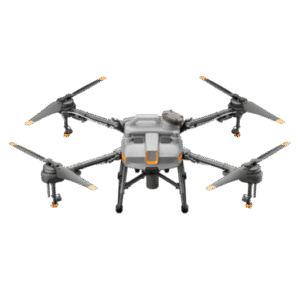
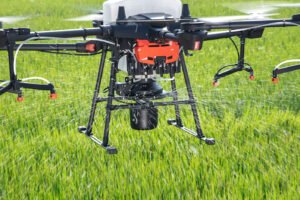
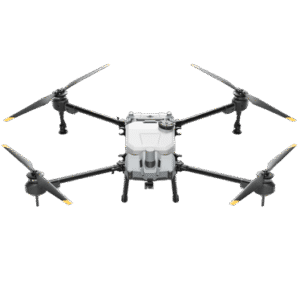
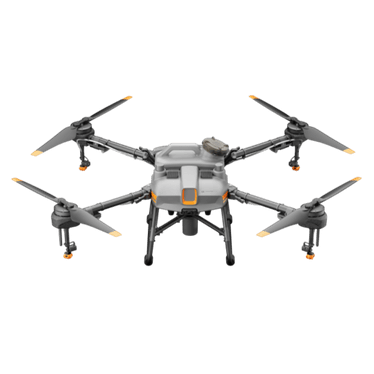
The DJI Agras T30 is a professional agricultural spraying and spreading drone with a 30 L tank, 16-nozzle spray system and radar-assisted flight features. It is designed for crop operations, not recreational aerial photography.
Spraying system
DJI specifies a 30 L operating tank and 30 kg full-load payload. The standard system has 16 nozzles. Maximum spray flow is listed as 7.2 L/min with the standard nozzle and 8 L/min with the optional nozzle. The stated effective spray width is 4–9 m in a 12-nozzle setup at 1.5–3 m above crops. These values depend on nozzle choice, crop canopy, flight speed, wind and liquid properties.
Radar and field operation
The T30 uses an omnidirectional radar and top-view radar. DJI lists obstacle perception from 1.5–30 m under specified conditions and terrain-following functions. These systems assist the pilot but do not replace field inspection, route planning or safe operating procedures.
DJI Agras T30 specifications
| Specification | Value |
|---|---|
| Tank / operating payload | 30 L / 30 kg |
| Nozzles | 16 |
| Maximum spray flow | 7.2 L/min standard; 8 L/min optional |
| Effective spray width | 4–9 m in stated setup |
| Obstacle sensing | Omnidirectional and top-view radar |
| Maximum operating speed | 7 m/s (DJI specification) |
| Maximum tolerable wind | 6 m/s (DJI specification) |
Independent field research
A 2026 peer-reviewed study in Agronomy evaluated spray deposition from the Agras T30 alongside aircraft and ground sprayers on tassel-stage corn. This research is useful context: tank size and pump flow alone do not prove how much spray reaches a crop canopy. Deposition varies with crop stage, weather, nozzle setup and flight parameters. The study’s results should not be generalized to other crops without checking its methods.
Who should consider the T30?
The T30 may suit agricultural contractors and farms needing a 30 L system with radar-assisted operation. Assess battery and charging logistics, chemical compatibility, operator training, spare-parts support and local agricultural-drone rules before purchase.
Advantages and limitations
- Advantages: 30 L tank, 16-nozzle system, optional higher-flow nozzle, radar assistance and spreading-system option.
- Limitations: actual spray deposition and field productivity depend on crop and conditions; specialist support and trained operators are essential.
Sources and verification
Technical figures are from DJI’s Agras T30 specifications and FAQ. Independent context: Pereira et al., “Evaluation of DJI AGRAS T30, Airplane, and Ground Sprayer Spray Deposition on Tassel-Stage Corn,” Agronomy (2026). This is a specification- and literature-based review, not a claim of hands-on testing.
Who should consider DJI Agras T30?
For agricultural contractors, the useful question is how the aircraft fits into a complete field service. Consider the number of jobs per day, refill distance, mixing and cleaning facilities, battery charging, generator capacity, transport vehicle, seasonal utilisation and trained crew availability. A high-capacity aircraft can still be inefficient if field logistics or service support are weak. For DJI Agras T30, validate application settings using the intended crop, material, nozzle or spreader and field layout rather than a generic demonstration.
Limitations and trade-offs to understand
The aircraft is only one part of the operating cost. Include batteries, chargers or generators, spare pumps and nozzles, filters, hoses, protective equipment, maintenance, chemical handling, transport and downtime. A seller's hectares-per-hour estimate should be checked against a real field layout and the required overlap, turning time and refill cycle. For DJI Agras T30, keep an operating log of weather, payload, settings, field area and refill time so that productivity claims can be checked.
Alternatives worth comparing
Compare other agricultural aircraft in the same operating class, such as the DJI Agras T20P, T25P, T40 or T50 where relevant, and consider whether a multispectral mapping platform such as the DJI Mavic 3 Multispectral is a better fit for crop monitoring rather than application. These are different mission types; they are not interchangeable. For DJI Agras T30, confirm the exact agricultural kit and regional support route before buying; aircraft-only specifications do not describe a complete spraying operation.
Pre-purchase and ownership checklist
Ask the supplier for the exact nozzle/spreader configuration, supported materials, calibration procedure, battery cycle expectations, charging plan, service response time and operator training. Request written confirmation of local registration, pilot qualification, agricultural chemical approvals and insurance obligations. Record the test conditions behind any productivity claim. For DJI Agras T30, plan cleaning, battery storage and chemical-handling procedures as part of the ownership cost.
How to use this specification profile
This page is a research-based reference, not a claim that IGIDRONE has independently flight-tested the aircraft. Treat manufacturer maximums as test-condition figures and distinguish standard equipment from optional accessories or regional bundles. Before buying, compare the exact model code, firmware, battery, controller and payload configuration against the current official manual. If a field is marked unknown or is not documented by the manufacturer, do not infer a value from a similarly named variant. For DJI Agras T30, validate application settings using the intended crop, material, nozzle or spreader and field layout rather than a generic demonstration.
Primary manufacturer reference: Open the manufacturer specification or support page. Confirm the current regional documentation before purchase. For DJI Agras T30, keep an operating log of weather, payload, settings, field area and refill time so that productivity claims can be checked.
Editorial update: 8 November 2026. Model availability, prices, software support and regional operating rules can change. Confirm them with the manufacturer, authorised distributor and relevant aviation authority before purchase or flight. For DJI Agras T30, confirm the exact agricultural kit and regional support route before buying; aircraft-only specifications do not describe a complete spraying operation.
Field workflow and productivity planning
Ask the dealer to show the application settings for your crop and material, including the calibration method and how flow is checked. Keep a record of the liquid or granule used, batch, area, weather, nozzle setup, operator and application rate. This makes it easier to investigate uneven coverage or drift and to repeat a successful job. For DJI Agras T30, validate application settings using the intended crop, material, nozzle or spreader and field layout rather than a generic demonstration.
Evidence to request from a supplier
Request a current operator manual, supported material list, maintenance schedule, parts catalogue and written regional service details. Ask for a field demonstration with the same tank, nozzle or spreading kit you intend to use. Productivity claims should identify crop, field shape, payload, flight height, speed, overlap, weather and refill assumptions. Do not use an unverified marketing estimate as the basis for chemical dosing or business revenue forecasts. For DJI Agras T30, keep an operating log of weather, payload, settings, field area and refill time so that productivity claims can be checked.
Editorial standard: buyer guidance is based on published manufacturer information and practical ownership considerations. IGIDRONE does not claim independent flight testing unless a page explicitly documents a real test. For DJI Agras T30, confirm the exact agricultural kit and regional support route before buying; aircraft-only specifications do not describe a complete spraying operation.
Drone Specifications
| Brand | DJI |
|---|---|
| Camera | Front/rear FPV cameras: 1,280 × 720, 15–30 fps; not a dedicated mapping or aerial-photography camera |
| Maximum Flight Time (minutes) | Hovering endurance: 20.5 min at 36.5 kg takeoff weight; 7.8 min at 66.5 kg takeoff weight (29,000 mAh battery; controlled tests) minutes |
| Maximum Transmission Range (km) | FCC: up to 7 km; CE/MIC/KCC: up to 4 km; SRRC: up to 5 km (OcuSync Industry Edition, unobstructed; aircraft altitude approx. 2.5 m) km |
| Weight (g) | 26.4 kg (without batteries) g |
| Battery Capacity (mAh) | 29,000 mAh mAh |
| Wind Resistance (m/s) | 6 m/s m/s |
| Obstacle Sensing | Omnidirectional spherical radar obstacle-avoidance system |
| Positioning / GPS | GPS + GLONASS |
| Maximum Speed (m/s) | 10 m/s (maximum level speed; maximum flight operation speed 7 m/s) m/s |
Additional Notes
DJI AGRAS T30: 26.4 kg without batteries; max takeoff weight 78 kg near sea level. Hovering endurance 20.5 min at 36.5 kg takeoff weight and 7.8 min at 66.5 kg, using 29,000 mAh battery; these are hover tests, not typical mission duration. Maximum level speed 10 m/s; operating speed 7 m/s; wind tolerance 6 m/s. OcuSync Industry Edition transmission: FCC 7 km, SRRC 5 km, MIC/KCC/CE 4 km in unobstructed conditions at approx. 2.5 m aircraft altitude. Front/rear FPV cameras are 720p, not a conventional payload imaging camera.
Specification source: Official source
Last verified: 2026-11-08
Official Price (USD)
No public USD price was verified on the manufacturer’s official store during this check.
For enterprise or discontinued models, contact the manufacturer for a current quotation. We do not substitute third-party seller prices.
Price checked: 2026-11-07
MODEL TECHNICAL RECORD
Detailed Technical Specifications
Manufacturer-specific technical information recorded for this model. Values not present in the source record are not estimated.
Feature
| Hourly work efficiency | 40 acres |
|---|---|
| High-precision radar | √ Spherical Omnidirectional Radar System |
| Remote control planning accuracy | √ (RTK/GNSS) |
| Pipe air exhaust | √ One button Air Discharge |
| 3D operation planning by the AI smart engine | √ |
| High-precision flowmeter | √ (Dual-channel electromagnetic flowmeter with an error of ±2%) |
| Level gauge | Continuous level gauge (with real-time pesticide load detection and intelligent supply-point prediction) |
| Maximum spray flow | 7.2L/min (with the XR11001 nozzle) 8L/min (with the XR110015 optional nozzle) |
| Pesticide tank installation method | Fixed pesticide tank |
| Battery installation method | Removable batteries |
| Single remote control for multiple drones | √ (Single remote control for up to three drones) |
| D-RTK technology | √ |
| Top-view radar module | √ |
| Flight laser function | √ |
| Intelligent endurance/return function | √ |
| Intelligent supply-point prediction | √ |
| Front-view FPV | √ |
| Rear-view FPV | √ |
| Coordinated turning function | √ |
| Branch targeting technology | √ |
Drone parameters
| Total weight (without batteries) | 26.4 kg |
|---|---|
| Maximum take-off weight | 78 kg (near sea level) |
| Maximum thrust-to-weight ratio | 1.70 @ takeoff weight of 66.5 kg |
| Hovering precision (with good GNSS signal) | With D-RTK enabled: ±10 cm (horizontal) and ±10 cm (vertical) With D-RTK disabled: ±0.6m (horizontal) and ±0.3m (vertical) (with the radar function enabled: ±0.1m) |
| RTK and GNSS frequency bands | RTK: GPS L1/L2, GLONASS F1/F2, BeiDou B1/B2, and Galileo E1/E5 GNSS: GPS L1, GLONASS F1, and Galileo E1 |
| Maximum power consumption | 11,000 W |
| Hovering power consumption | 10,000 W (@ takeoff weight of 66.5 kg) |
| Hovering endurance | 20.5min (@29,000 mAh & takeoff weight of 36.5 kg) 7.8min (@29,000 mAh & takeoff weight of 66.5 kg) |
| Maximum pitch angle | 15° |
| Maximum operating flight speed | 7 m/s |
| Maximum level speed | 10 m/s (with good GNSS signal) |
| Maximum tolerable wind speed | 6 m/s |
| Maximum flight altitude | 4,500m *Reduce the pesticide load by 12% for each increase of 1,000 meters in altitude. |
| Recommended operating ambient humidity | < 93% |
| Recommended operating ambient temperature | 0℃ to 45℃ |
Chassis parameters
| Maximum rotor distance | 2,145 mm |
|---|---|
| Dimensions | 2,858 mm × 2,685 mm × 790 mm (with arms and blades unfolded) 2,030 mm × 1,866 mm × 790 mm (with arms unfolded and blades folded) 1,170 mm × 670 mm × 857 mm (with arms folded) |
Power system - Motor
| Stator size | 100×18 mm |
|---|---|
| KV value | 77 rpm/V |
| Maximum pull | 18.7 kg/rotor |
| Maximum power | 3,600 W/rotor |
| Weight | 756 g |
Power system - Propellers
| Diameter × pitch | 38×20 inch |
|---|---|
| Weight (with a single blade) | 106 g |
Power system - ESC
| Maximum operating current (continuous) | 60 A |
|---|---|
| Maximum operating voltage | 60.9 V (14S LiPo) |
FPV cameras
| View angle (FOV) | Horizontal: 129°, vertical:82° |
|---|---|
| Resolution | 1,280×720 15-30 fps |
FPV searchlights
| Maximum light intensity | 13.2 lux @ 5-meter direct light |
|---|
Spraying system - Operation tank
| Operation tank volume | 30L at full load |
|---|---|
| Operating load | 30 kg at full load |
Spraying system - Nozzles
| Nozzle model | SX11001VS (standard) SX110015VS (optional) Fruit tree drones: TX-VK04 (optional) |
|---|---|
| Nozzle quantity | 16 |
| Maximum spray flow | SX11001VS: 7.2L/min SX110015VS: 8L/min TX-VK4:3.6 L/min |
| Atomized particle size | SX11001VS : 130 - 250 μm SX110015VS : 170 - 265 μm TX-VK4: 110 - 135 μm (depending on the actual operating environment, spray flow, and other factors) |
| Maximum effective spray width | 4-9 m (with 12 nozzles and a distance of 1.5 to 3 meters to crops) |
Spraying system - Water pump
| Water pump model | Plunger pump |
|---|---|
| Operating voltage | 60 V |
| Maximum flow | 4 L/min ×1 |
Spraying system - Flowmeter
| Flow measurement range | 0.25 - 20 L/min |
|---|---|
| Flow measurement error | < ±2% |
| Measurable liquid | Conductivity > 50 μS/cm, typical liquids: Tap water or aqueous organic or inorganic pesticides |
Omnidirectional obstacle avoidance radar
| Model | RD2424R |
|---|---|
| Operating frequency | SRRC/NCC/FCC: 24.05 - 24.25 GHz MIC/KCC/CE: 24.05 - 24.25 GHz |
| Operating power consumption | 12 W |
| Equivalent isotropic radiated power (EIRP) | SRRC: < 13 dBm; NCC/MIC/KCC/CE/FCC:< 20 dBm |
| Height maintenance and terrain adaptation | Height measurement range: 1-30 m Height-maintenance range: 1.5-15 m Maximum slope in mountain mode:35° |
| Obstacle avoidance system | Perceivable distance: 1.5-30 m View angle (FOV): Horizontal: 360°, vertical: ±15° Conditions of use: The relative altitude of the drone must be greater than 1.5 m and the speed less than 7 m/s Safety distance: 2.5 m (the distance between the tip of the propeller and the obstacle after the drone decelerates to a hover) Obstacle avoidance direction: Horizontally omnidirectional obstacle avoidance |
| Water-resistance rating | IP67 |
Top-view radar
| Model | RD2414U |
|---|---|
| Operating frequency | SRRC/NCC/FCC:24.05 - 24.25 GHz MIC/KCC/CE:24.05 - 24.25 GHz |
| Overhead obstacle avoidance | Perceivable distance: 1.5-10 m View angle (FOV): 80° Conditions of use: During take-off, landing, and climbing when the relative distance between the drone and the object above is greater than 1.5 m Safety distance: 2 m (the distance between the highest point on the top of the drone and the obstacle after the drone brakes and hovers stably) Obstacle avoidance direction: Above the drone |
| Water-resistance rating | IP67 |
| Equivalent isotropic radiated power (EIRP) | SRRC:< 13 dBm; NCC/MIC/KCC/CE/ FCC:< 20 dBm |
| Operating power consumption | 4 W |
Battery
| Model | BAX501-29,000mAh-51.8V |
|---|---|
| Weight | Approximately 10.1 kg |
| Discharge rate | 11.5C |
| Water-resistance rating | IP54 with board-level potting protection |
| Capacity | 29,000 mAh |
| Voltage | 51.8 V |
Remote control
| Model | RM500-ENT |
|---|---|
| Operating frequency of the Ocusync Industry Edition | 2.4000 - 2.4835 GHz 5.725 - 5.850 GHz |
| Effective signal range at the Ocusync Industry Edition operating frequency (without interference and blockage) | SRRC: 5 km; MIC/KCC/CE: 4 km; FCC: 7 km (measured when the operating height of the drone is 2.5 m) |
| EIRP of the operating frequency of the Ocusync Industry Edition | 2.4 GHz SRRC/CE/MIC/KCC: 18.5 dBm; FCC: 29.5 dBm; 5.8 GHz SRRC: 20.5 dBm; FCC: 28.5 dBm CE:12.5 dBm |
| Wi-Fi protocols | Wi-Fi Direct, Wireless Display, and 802.11a/g/n/ac Supports 2 × 2 MIMO Wi-Fi |
| Wi-Fi operating frequency | 2.4000 - 2.4835 GHz 5.150 - 5.250 GHz 5.725 - 5.850 GHz |
| Wi-Fi EIRP | 2.4 GHz SRRC/CE: 18.5 dBm; FCC/MIC/KCC:20.5 dBm; 5.2 GHz SRRC/FCC/CE/MIC: 14 dBm; KCC: 10 dBm; 5.8 GHz SRRC/FCC: 18 dBm; CE/KCC: 12 dBm; |
| Bluetooth protocol | Bluetooth 4.2 |
| Bluetooth operating frequency | 2.4000 - 2.4835 GHz |
| Bluetooth EIRP | SRRC/MIC/FCC/CE/KCC:6.5 dBm |
| Positioning | GPS+GLONASS dual mode |
| Display screen | 5.5-inch screen with a resolution of 1920×1080, brightness of 1,000 cd/m², and Android OS |
| Operating memory (RAM) | 4GB LPDDR4 |
| Storage space (ROM) | A microSD card with 32 GB and extensible storage space for up to 128 GB, transfer speed rated as UHS-I Speed Grade 3 |
| HDMI | HDMI 1.4 |
| Supported drones | T30 and T10 agricultural drones |
| Operating power consumption | 18 W |
| Operating ambient temperature | -10℃ to 40℃ |
| Storage ambient temperature | -30℃ to 60℃ (within 1 month) -30℃ to 45℃ (more than 1 month and less than 3 months) -30℃ to 35℃ (more than 3 months and less than 6 months) -30℃ to 25℃ (more than 6 months) (with built-in batteries charged to 40% to 60%) |
| Charging ambient temperature | 5℃ to 40℃ |
Built-in batteries of the remote control
| Built-in batteries | 18650 lithium-ion battery (5,000 mAh at 7.2V) |
|---|---|
| Battery life | 2 hours |
| Charging method | Use a standard 12V/2A USB fast charger |
| Charging time | 2.5 hours (use the 12V/2A USB fast charger when the remote control is powered off) |
| Power supply current/voltage of the remote control USB-A port | 5 V / 1.5 A |
External smart battery of the remote control
| Model | WB37-4,920mAh-7.6V |
|---|---|
| Battery type | 2S LiPo |
| Capacity | 4,920 mAh |
| Voltage | 7.6 V |
| Capacity (2) | 37.39 Wh |
| Charging ambient temperature | 5℃ to 40℃ |
| Battery life | 2 hours |
Charging assistant of the remote control external smart battery
| Model | WCH2 |
|---|---|
| Input voltage | 17.3 - 26.2 V |
| Output voltage and current | 8.7V and 6A |
| Operating ambient temperature | 5℃ to 40℃ |
Power adapter of the external smart battery charging assistant
| Model | A14-057N1A |
|---|---|
| Input voltage | 100 - 240V and 50/60 Hz |
| Output voltage | 17.4 V |
| Rated power | 57 W |
T30 Spreading System 3.0
| Spreading system weight | 3.9kg |
|---|---|
| Maximum opening area | 44.6 cm² |
| Applicable materials | Solid dry particles with a diameter of 0.5 to 5 mm |
| Spreading tank volume | 40L |
| Maximum load of the spreading tank | 35kg |
| Water-resistance rating | IP67 |
| Input voltage | Power: 60V Control:15V |
| Maximum power | 60V@250W 15V@50W |
| Recommended operating ambient temperature | 0℃ to 40℃ |
| Dimensions | 560×435×320mm |
| Maximum rotation speed | 1,300 RPM |
T30 smart charging manager
| Dimensions | 300×280×230 mm |
|---|---|
| Total weight | 11.5 kg |
| Input voltage | 100-264 Vac |
| Output voltage | 40-60 V |
| Rated power | 7,200 |
| Charging current | 120 A |
| Charging time | Fully charges a battery in 9 to 12 minutes |
| Charging voltage accuracy | +/-0.1 V |
| Charging current accuracy | +/-1 A |
| Output channel quantity | 2 |
| Protection functions | Over-temperature, over-voltage, under-voltage, short-circuit, and fan stall protection |
| Charging ambient temperature | -20℃ to 45℃ |
| Charging safety | AC wire protection, power wire protection, and charge connector protection |
Others
| Guaranteed software updates until | 2026/12/31 |
|---|


MANUFACTURER DATA
Detailed official specifications
Technical figures below are transcribed from the manufacturer documentation linked with this profile. Test figures are maximum or controlled-condition ratings where stated; actual performance varies by configuration and operating conditions. A field is omitted when the cited source does not publish a reliable value.
Manufacturer source last checked: 2026-11-08
Evidence type: Official DJI manufacturer specifications / support documentation
Feature
| Hourly work efficiency | 40 acres |
|---|---|
| High-precision radar | √ Spherical Omnidirectional Radar System |
| Remote control planning accuracy | √ (RTK/GNSS) |
| Pipe air exhaust | √ One button Air Discharge |
| 3D operation planning by the AI smart engine | √ |
| High-precision flowmeter | √ (Dual-channel electromagnetic flowmeter with an error of ±2%) |
| Level gauge | Continuous level gauge (with real-time pesticide load detection and intelligent supply-point prediction) |
| Maximum spray flow | 7.2L/min (with the XR11001 nozzle); 8L/min (with the XR110015 optional nozzle) |
| Pesticide tank installation method | Fixed pesticide tank |
| Battery installation method | Removable batteries |
| Single remote control for multiple drones | √ (Single remote control for up to three drones) |
| D-RTK technology | √ |
| Top-view radar module | √ |
| Flight laser function | √ |
| Intelligent endurance/return function | √ |
| Intelligent supply-point prediction | √ |
| Front-view FPV | √ |
| Rear-view FPV | √ |
| Coordinated turning function | √ |
| Branch targeting technology | √ |
Drone parameters
| Total weight (without batteries) | 26.4 kg |
|---|---|
| Maximum take-off weight | 78 kg (near sea level) |
| Maximum thrust-to-weight ratio | 1.70 @ takeoff weight of 66.5 kg |
| Hovering precision (with good GNSS signal) | With D-RTK enabled: ; ±10 cm (horizontal) and ±10 cm (vertical); With D-RTK disabled: ; ±0.6m (horizontal) and ±0.3m (vertical) (with the radar function enabled: ±0.1m) |
| RTK and GNSS frequency bands | RTK: GPS L1/L2, GLONASS F1/F2, BeiDou B1/B2, and Galileo E1/E5; GNSS: GPS L1, GLONASS F1, and Galileo E1 |
| Maximum power consumption | 11,000 W |
| Hovering power consumption | 10,000 W (@ takeoff weight of 66.5 kg) |
| Hovering endurance | 20.5min (@29,000 mAh & takeoff weight of 36.5 kg); 7.8min (@29,000 mAh & takeoff weight of 66.5 kg) |
| Maximum pitch angle | 15° |
| Maximum operating flight speed | 7 m/s |
| Maximum level speed | 10 m/s (with good GNSS signal) |
| Maximum tolerable wind speed | 6 m/s |
| Maximum flight altitude | 4,500m; *Reduce the pesticide load by 12% for each increase of 1,000 meters in altitude. |
| Recommended operating ambient humidity | < 93% |
| Recommended operating ambient temperature | 0℃ to 45℃ |
Chassis parameters
| Maximum rotor distance | 2,145 mm |
|---|---|
| Dimensions | 2,858 mm × 2,685 mm × 790 mm (with arms and blades unfolded); 2,030 mm × 1,866 mm × 790 mm (with arms unfolded and blades folded); 1,170 mm × 670 mm × 857 mm (with arms folded) |
Power system - Motor
| Stator size | 100×18 mm |
|---|---|
| KV value | 77 rpm/V |
| Maximum pull | 18.7 kg/rotor |
| Maximum power | 3,600 W/rotor |
| Weight | 756 g |
Power system - Propellers
| Diameter × pitch | 38×20 inch |
|---|---|
| Weight (with a single blade) | 106 g |
Power system - ESC
| Maximum operating current (continuous) | 60 A |
|---|---|
| Maximum operating voltage | 60.9 V (14S LiPo) |
FPV cameras
| View angle (FOV) | Horizontal: 129°, vertical:82° |
|---|---|
| Resolution | 1,280×720 15-30 fps |
FPV searchlights
| Maximum light intensity | 13.2 lux @ 5-meter direct light |
|---|
Spraying system - Operation tank
| Operation tank volume | 30L at full load |
|---|---|
| Operating load | 30 kg at full load |
Spraying system - Nozzles
| Nozzle model | SX11001VS (standard); SX110015VS (optional); Fruit tree drones: TX-VK04 (optional) |
|---|---|
| Nozzle quantity | 16 |
| Maximum spray flow | SX11001VS: 7.2L/min; SX110015VS: 8L/min; TX-VK4:3.6 L/min |
| Atomized particle size | SX11001VS : 130 - 250 μm; SX110015VS : 170 - 265 μm; TX-VK4: 110 - 135 μm; (depending on the actual operating environment, spray flow, and other factors) |
| Maximum effective spray width | 4-9 m (with 12 nozzles and a distance of 1.5 to 3 meters to crops) |
Spraying system - Water pump
| Water pump model | Plunger pump |
|---|---|
| Operating voltage | 60 V |
| Maximum flow | 4 L/min ×1 |
Spraying system - Flowmeter
| Flow measurement range | 0.25 - 20 L/min |
|---|---|
| Flow measurement error | < ±2% |
| Measurable liquid | Conductivity > 50 μS/cm, typical liquids: Tap water or aqueous organic or inorganic pesticides |
Omnidirectional obstacle avoidance radar
| Model | RD2424R |
|---|---|
| Operating frequency | SRRC/NCC/FCC: 24.05 - 24.25 GHz; MIC/KCC/CE: 24.05 - 24.25 GHz |
| Operating power consumption | 12 W |
| Equivalent isotropic radiated power (EIRP) | SRRC: < 13 dBm; NCC/MIC/KCC/CE/FCC:< 20 dBm |
| Height maintenance and terrain adaptation | Height measurement range: 1-30 m; Height-maintenance range: 1.5-15 m; Maximum slope in mountain mode:35° |
| Obstacle avoidance system | Perceivable distance: 1.5-30 m; View angle (FOV): Horizontal: 360°, vertical: ±15°; Conditions of use: The relative altitude of the drone must be greater than 1.5 m and the speed less than 7 m/s; Safety distance: 2.5 m (the distance between the tip of the propeller and the obstacle after the drone decelerates to a hover); Obstacle avoidance direction: Horizontally omnidirectional obstacle avoidance |
| Water-resistance rating | IP67 |
Top-view radar
| Model | RD2414U |
|---|---|
| Operating frequency | SRRC/NCC/FCC:24.05 - 24.25 GHz; MIC/KCC/CE:24.05 - 24.25 GHz |
| Overhead obstacle avoidance | Perceivable distance: 1.5-10 m; View angle (FOV): 80°; Conditions of use: During take-off, landing, and climbing when the relative distance between the drone and the object above is greater than 1.5 m; Safety distance: 2 m (the distance between the highest point on the top of the drone and the obstacle after the drone brakes and hovers stably); Obstacle avoidance direction: Above the drone |
| Water-resistance rating | IP67 |
| Equivalent isotropic radiated power (EIRP) | SRRC:< 13 dBm; NCC/MIC/KCC/CE/; FCC:< 20 dBm |
| Operating power consumption | 4 W |
Battery
| Model | BAX501-29,000mAh-51.8V |
|---|---|
| Weight | Approximately 10.1 kg |
| Discharge rate | 11.5C |
| Water-resistance rating | IP54 with board-level potting protection |
| Capacity | 29,000 mAh |
| Voltage | 51.8 V |
Remote control
| Model | RM500-ENT |
|---|---|
| Operating frequency of the Ocusync Industry Edition | 2.4000 - 2.4835 GHz; 5.725 - 5.850 GHz |
| Effective signal range at the Ocusync Industry Edition operating frequency (without interference and blockage) | SRRC: 5 km; MIC/KCC/CE: 4 km; FCC: 7 km; (measured when the operating height of the drone is 2.5 m) |
| EIRP of the operating frequency of the Ocusync Industry Edition | 2.4 GHz; SRRC/CE/MIC/KCC: 18.5 dBm; ; FCC: 29.5 dBm; ; 5.8 GHz; SRRC: 20.5 dBm; ; FCC: 28.5 dBm; CE:12.5 dBm |
| Wi-Fi protocols | Wi-Fi Direct, Wireless Display, and 802.11a/g/n/ac; Supports 2 × 2 MIMO Wi-Fi |
| Wi-Fi operating frequency | 2.4000 - 2.4835 GHz; 5.150 - 5.250 GHz; 5.725 - 5.850 GHz |
| Wi-Fi EIRP | 2.4 GHz; SRRC/CE: 18.5 dBm; FCC/MIC/KCC:20.5 dBm; ; 5.2 GHz; SRRC/FCC/CE/MIC: 14 dBm; KCC: 10 dBm; ; 5.8 GHz; SRRC/FCC: 18 dBm; CE/KCC: 12 dBm; |
| Bluetooth protocol | Bluetooth 4.2 |
| Bluetooth operating frequency | 2.4000 - 2.4835 GHz |
| Bluetooth EIRP | SRRC/MIC/FCC/CE/KCC:6.5 dBm |
| Positioning | GPS+GLONASS dual mode |
| Display screen | 5.5-inch screen with a resolution of 1920×1080, brightness of 1,000 cd/m², and Android OS |
| Operating memory (RAM) | 4GB LPDDR4 |
| Storage space (ROM) | A microSD card with 32 GB and extensible storage space for up to 128 GB, transfer speed rated as UHS-I Speed Grade 3 |
| HDMI | HDMI 1.4 |
| Supported drones | T30 and T10 agricultural drones |
| Operating power consumption | 18 W |
| Operating ambient temperature | -10℃ to 40℃ |
| Storage ambient temperature | -30℃ to 60℃ (within 1 month); -30℃ to 45℃ (more than 1 month and less than 3 months); -30℃ to 35℃ (more than 3 months and less than 6 months); -30℃ to 25℃ (more than 6 months); (with built-in batteries charged to 40% to 60%) |
| Charging ambient temperature | 5℃ to 40℃ |
Built-in batteries of the remote control
| Built-in batteries | 18650 lithium-ion battery (5,000 mAh at 7.2V) |
|---|---|
| Battery life | 2 hours |
| Charging method | Use a standard 12V/2A USB fast charger |
| Charging time | 2.5 hours (use the 12V/2A USB fast charger when the remote control is powered off) |
| Power supply current/voltage of the remote control USB-A port | 5 V / 1.5 A |
External smart battery of the remote control
| Model | WB37-4,920mAh-7.6V |
|---|---|
| Battery type | 2S LiPo |
| Capacity | 37.39 Wh |
| Voltage | 7.6 V |
| Charging ambient temperature | 5℃ to 40℃ |
| Battery life | 2 hours |
Charging assistant of the remote control external smart battery
| Model | WCH2 |
|---|---|
| Input voltage | 17.3 - 26.2 V |
| Output voltage and current | 8.7V and 6A |
| Operating ambient temperature | 5℃ to 40℃ |
Power adapter of the external smart battery charging assistant
| Model | A14-057N1A |
|---|---|
| Input voltage | 100 - 240V and 50/60 Hz |
| Output voltage | 17.4 V |
| Rated power | 57 W |
T30 Spreading System 3.0
| Spreading system weight | 3.9kg |
|---|---|
| Maximum opening area | 44.6 cm² |
| Applicable materials | Solid dry particles with a diameter of 0.5 to 5 mm |
| Spreading tank volume | 40L |
| Maximum load of the spreading tank | 35kg |
| Water-resistance rating | IP67 |
| Input voltage | Power: 60V; Control:15V |
| Maximum power | 60V@250W; 15V@50W |
| Recommended operating ambient temperature | 0℃ to 40℃ |
| Dimensions | 560×435×320mm |
| Maximum rotation speed | 1,300 RPM |
T30 smart charging manager
| Dimensions | 300×280×230 mm |
|---|---|
| Total weight | 11.5 kg |
| Input voltage | 100-264 Vac |
| Output voltage | 40-60 V |
| Rated power | 7,200 |
| Charging current | 120 A |
| Charging time | Fully charges a battery in 9 to 12 minutes |
| Charging voltage accuracy | +/-0.1 V |
| Charging current accuracy | +/-1 A |
| Output channel quantity | 2 |
| Protection functions | Over-temperature, over-voltage, under-voltage, short-circuit, and fan stall protection |
| Charging ambient temperature | -20℃ to 45℃ |
| Charging safety | AC wire protection, power wire protection, and charge connector protection |
Others
| Guaranteed software updates until | 2026/12/31 |
|---|
Source: manufacturer technical specifications and official support documentation. Regional versions, payloads, batteries, firmware and test conditions can change the stated figures. Check the linked source for the applicable configuration.
Related Dji drones
Explore other published models from the same manufacturer.