
The DJI Matrice 350 RTK is an enterprise aircraft for surveying, mapping, inspection and public-safety work. Its value depends on the complete system, not only the aircraft. Payload choice, RTK setup, mission planning, data processing, training and service support all affect whether it fits a professional operation.
Review scope: This article is a research-based overview of DJI’s published specifications and supported workflows. It is not a hands-on flight test.
Confirm aircraft, payload and firmware compatibility with DJI or an authorised enterprise dealer before committing to a project.
DJI Matrice 350 RTK: key features
- Up to 55 minutes maximum flight time in DJI’s stated no-payload test conditions.
- RTK positioning, with stated RTK FIX accuracy of 1 cm + 1 ppm horizontally and 1.5 cm + 1 ppm vertically.
- IP55 aircraft protection rating, subject to wear and correct maintenance.
- DJI O3 Enterprise video transmission, with maximum unobstructed distance varying by region.
- TB65 dual-battery system and hot-swappable battery workflow.
- Support for selected Zenmuse cameras, LiDAR and other compatible payloads.
- Operating temperature range listed by DJI as -20°C to 50°C.
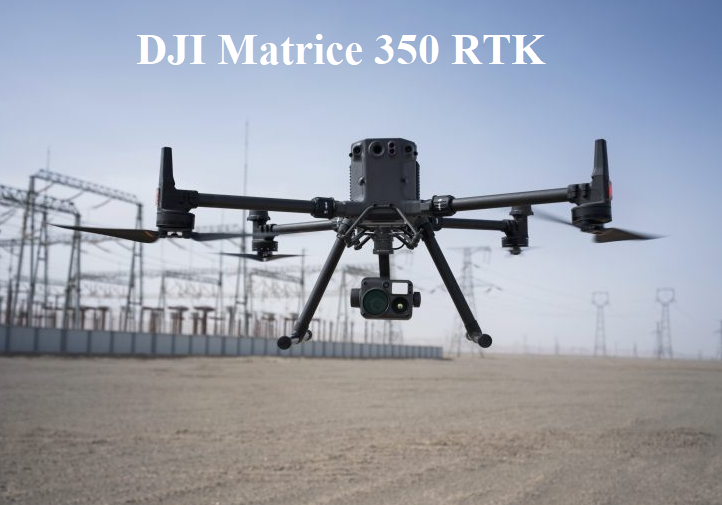
Detailed DJI Matrice 350 RTK specifications
| Specification | DJI-published information |
|---|---|
| Maximum takeoff weight | 9.2 kg |
| Weight with two TB65 batteries and single downward gimbal damper | Approx. 6.47 kg |
| Weight without batteries (single downward gimbal damper) | Approx. 3.77 kg |
| Dimensions, unfolded (without propellers) | 810 × 670 × 430 mm |
| Dimensions, folded (with propellers) | 430 × 420 × 430 mm |
| Diagonal wheelbase | 895 mm |
| Maximum flight time | 55 minutes (no-payload test conditions) |
| Maximum horizontal speed | 23 m/s |
| Maximum ascent speed | 6 m/s |
| Maximum vertical descent speed | 5 m/s |
| Maximum wind resistance | 12 m/s |
| Maximum flight altitude | 5,000 m with standard propellers and specified takeoff weight; up to 7,000 m with compatible high-altitude propellers and lower specified takeoff weight |
| Operating temperature | -20°C to 50°C |
| Ingress protection | IP55 (rating can decrease with wear) |
| Satellite navigation | GPS, GLONASS, BeiDou and Galileo |
| RTK FIX accuracy | 1 cm + 1 ppm horizontal; 1.5 cm + 1 ppm vertical |
| Video transmission | DJI O3 Enterprise |
| Maximum transmission distance | 20 km FCC; 8 km CE/SRRC/MIC, unobstructed and interference-free |
| Supported payload families | Selected Zenmuse H30/H30T, H20 series, L1/L2, P1 and other DJI-listed compatible payloads |
Important: Maximum flight time, altitude and transmission range depend on the test configuration and regional rules. The 55-minute figure is measured without payload in a controlled flight profile.
Payload weight, wind, temperature, battery health and mission pattern reduce usable endurance. The 7,000 m ceiling applies only with the specified high-altitude propellers and takeoff-weight limit.
RTK positioning and mapping accuracy
RTK can improve positioning when the aircraft receives valid correction data and maintains an RTK FIX solution. DJI lists RTK FIX accuracy of 1 cm + 1 ppm horizontally and 1.5 cm + 1 ppm vertically.
These figures describe the positioning system. They do not guarantee the same accuracy in every finished map or 3D model.
Survey quality depends on the complete workflow. Teams should check camera or LiDAR calibration, flight height, image overlap and ground control.
Satellite geometry, correction-link quality, weather and processing settings also matter. Set quality-control procedures before the mission.
Then validate the final data against the accuracy required by the client.
Payloads: choose the sensor for the job
| Payload family | Typical professional use |
|---|---|
| Zenmuse P1 | Photogrammetry and high-resolution mapping workflows. |
| Zenmuse L1 / L2 | LiDAR capture and point-cloud mapping workflows. |
| Zenmuse H20 / H20T | Multi-sensor inspection and thermal observation, depending on model. |
| Zenmuse H30 / H30T | Long-range visual and thermal inspection workflows, depending on model. |
Payload availability, firmware support, gimbal position and simultaneous configurations are not interchangeable. Check DJI’s current compatibility matrix and the exact aircraft firmware before purchase.
A payload’s presence in a product family does not mean every combination can be installed at once.
Battery system, protection and field operations
The TB65 battery system is designed for enterprise field use, including hot-swapping in supported workflows. Teams should still follow battery inspection, charging, storage and transport guidance.
Keep a reserve for return and landing, rotate batteries according to health and cycle data, and plan for charging logistics on remote sites.
IP55 is a defined dust and water-ingress protection rating, not permission to fly in any weather. The rating may reduce as equipment ages or is damaged.
Follow DJI’s restrictions for precipitation, wind, temperature and maintenance, and inspect seals and aircraft condition before demanding missions.
DJI Matrice 350 RTK vs Matrice 300 RTK
| Consideration | Matrice 350 RTK | Matrice 300 RTK |
|---|---|---|
| Platform position | Updated enterprise platform | Previous-generation enterprise platform |
| Battery system | TB65 battery system | TB60 battery system |
| Transmission | DJI O3 Enterprise | OcuSync Enterprise |
| Protection rating | IP55 | IP45 |
| Upgrade decision | Attractive where updated battery, transmission and protection features matter | May remain suitable where existing payloads, batteries, training and workflows are already in place |
For an organisation already using the M300 RTK, compare total lifecycle costs rather than headline specifications alone. Check payload compatibility, spare batteries and charging equipment.
Also include software, training, service support and any changes to operating procedures. See the IGIDRONE Matrice 300 RTK review and Matrice 300 RTK specifications.
Pros and cons
Advantages
- RTK support is valuable for workflows that require accurate georeferencing and controlled survey procedures.
- Broad support for DJI enterprise imaging, thermal and mapping payload families.
- IP55 rating and a wide stated operating-temperature range suit demanding professional environments when used within DJI limits.
- TB65 battery workflow and hot-swapping can help reduce field downtime.
- Multiple gimbal configurations support different mission requirements.
Limitations
- The aircraft and compatible payloads represent a substantial professional investment; the total system cost can be much higher than the airframe price.
- It is large and heavy compared with consumer camera drones and requires trained operators and mission planning.
- Published maximum flight time is a no-payload test result, not a typical sensor-equipped mission duration.
- RTK does not by itself guarantee survey-grade map accuracy; the complete workflow must be controlled and validated.
- IP55 does not mean waterproof or maintenance-free, and protection can decline with wear.
Who should consider the Matrice 350 RTK?
Potentially suitable: surveying companies, infrastructure inspection teams, utilities, public-safety organisations and industrial operators that need interchangeable specialist payloads, RTK workflows and an enterprise support structure.
Probably excessive: casual hobby pilots, travel creators and small businesses that only need standard aerial photos or video. A consumer or prosumer camera drone is generally simpler and less costly for those jobs.
Buying advice for organisations
- Define the mission first: mapping, LiDAR, thermal inspection, visual inspection or public safety.
- Choose the payload and software workflow before requesting an aircraft quotation.
- Ask the dealer for a complete bill of materials: aircraft, controller, batteries, charging station, payload, cases, software and training.
- Confirm current aircraft-payload-firmware compatibility in writing.
- Calculate operating cost, battery replacement, maintenance, insurance, training and data-processing costs.
- Check local aviation permissions, radio rules, privacy requirements and any restrictions on sensitive sites or data.
- Request a demonstration using a representative mission and evaluate the resulting data, not just the flight.
Price and availability
Enterprise prices vary by payload, controller, battery quantity, service plan, country and dealer. A historic launch price is not a reliable current market price.
Ask an authorised DJI Enterprise dealer for an itemised quotation. Compare the complete aircraft, payload and support package.
Final verdict
The Matrice 350 RTK is best evaluated as a configurable enterprise data-collection platform. RTK positioning, supported Zenmuse payloads, the TB65 battery system and IP55 protection are meaningful advantages for professional teams.
It is not automatically the right choice for every survey or inspection: select it only when the required sensor, accuracy workflow, training and service support justify the investment.
Explore more: Matrice 350 RTK specifications · DJI comparison tool · DJI drone catalogue.
Official source and editorial note
Primary source: DJI Matrice 350 RTK official support and specifications. DJI may revise specifications, supported payloads and firmware notes.
Verify current documentation and local operating requirements before purchasing or flying. This is a research-based overview, not an independent field test.
Enterprise fleet decision: keep the M300 RTK or move to M350 RTK?
Treat the Matrice 350 RTK as a fleet-system upgrade, not just a newer aircraft. DJI lists the M350 with a TB65 battery system, IP55 protection and O3 Enterprise transmission, compared with the M300’s TB60 batteries, IP45 rating and OcuSync Enterprise.
Both have a manufacturer-listed maximum flight time of up to 55 minutes under defined conditions. The M350’s higher protection rating and updated transmission may matter to teams working in demanding environments, but neither headline specification alone proves that replacing a working M300 fleet is financially sensible.
Payload and accessory migration
Before moving from M300 to M350, list every aircraft, gimbal, payload, connector and firmware version. Also check controllers, batteries, chargers, RTK equipment and software licences. Do not assume a payload that works on the M300 will work on the M350 without an adapter, firmware update or different mounting arrangement.
Ask DJI or an authorised enterprise supplier to confirm compatibility in writing for the exact configuration and intended mission.
Lifecycle cost and upgrade triggers
Calculate the full transition cost. Include aircraft, TB65 batteries, chargers, payload adapters, spares, training, insurance, software and downtime. Also account for resale or disposal of old equipment. An upgrade is easier to justify when the M300 fleet has rising maintenance costs, battery supply is difficult, a required payload or feature is unsupported, or the M350’s protection and transmission materially reduce operational risk.
If the M300 fleet is reliable, supported and already integrated into validated workflows, retaining it may be more cost-effective.
Mission-based recommendation
- Surveying: compare payload compatibility, RTK workflow, calibration and client accuracy requirements before switching.
- Utilities and infrastructure: assess weather exposure, radio environment, stand-off distance and the value of the M350’s updated platform features.
- Public safety: assess fleet standardisation, training, data security, dispatch workflow and local operating approvals.
- New enterprise fleet: compare current support horizon, payload ecosystem, battery availability and total cost across available platforms rather than selecting on age alone.
Regional compliance and editorial note
In India, verify current DGCA and Digital Sky requirements for the exact aircraft and mission. In the United States, check FAA registration, Remote ID, Part 107 and airspace permissions.
In the EU, check EASA category, aircraft class, operator and pilot requirements, geo-zones and any Specific-category authorisation. Local site, privacy and data-security rules may also apply.
This is a research-based fleet-planning analysis, not a hands-on test or legal advice. Confirm current DJI compatibility and support documentation before procurement.
Matrice 350 RTK: upgrade and fleet decision
Owners of Matrice 300 RTK fleets should not treat the 350 RTK as an automatic replacement. The decision depends on the aircraft condition, battery ecosystem, payload compatibility, controller and software transition, training burden and the value of improved operating workflows.
Build a payload-by-payload compatibility matrix before committing: list each camera, sensor, mount, cable, firmware requirement and mission application used by the team.
For a new fleet, calculate total cost of ownership across aircraft, batteries, charging, payloads, RTK infrastructure, spares, training, insurance and service response. Ask the supplier to demonstrate the exact payload and workflow rather than relying on a generic compatibility statement.
The review discusses the purchase decision; the Matrice 350 RTK specification profile is the structured model reference.