Photo: Sinky · Licence: CC BY-SA 4.0 · View the original source and licence terms.
DJI / DRONE PROFILE
DJI Mavic Pro
Explore the available technical information for this aircraft, including camera capabilities, flight performance and manufacturer-specific specifications.
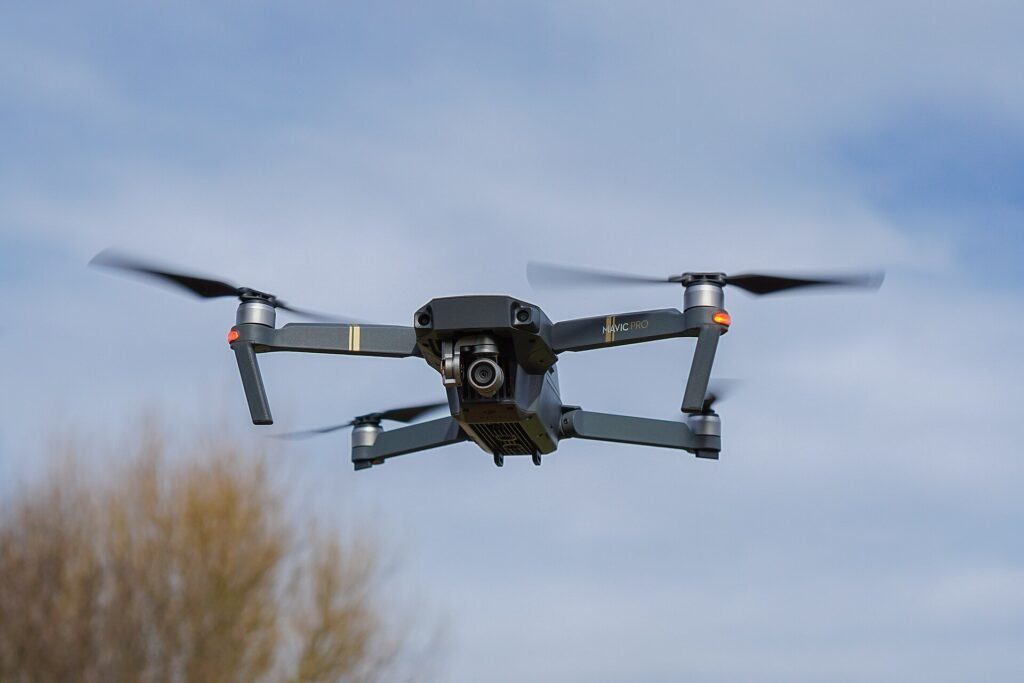
The original DJI Mavic Pro helped establish the folding camera-drone category by combining a portable airframe with a three-axis stabilised camera. It is an older model, but it remains relevant to buyers considering used equipment or comparing the evolution of DJI’s Mavic line.
Camera and flight platform
DJI’s published Mavic Pro specifications list a 1/2.3-inch CMOS camera with approximately 12 MP effective pixels, a 3-axis gimbal and GPS/GLONASS positioning. DJI lists up to 27 minutes maximum flight time under a specific no-wind test condition, and a maximum Sport-mode speed of 65 km/h under stated conditions. These are laboratory-style manufacturer figures, not expected results on every flight.
Portability and obstacle sensing
The folding arms make the Mavic Pro easier to pack than many earlier camera drones. Its forward and downward vision systems support obstacle awareness and positioning in suitable lighting and surface conditions. They do not provide the omnidirectional sensing available on newer aircraft, so pilots must maintain clearance and avoid relying on sensors in poor visibility.
Used-buying advice
Inspect battery cycles and swelling, gimbal movement, camera focus, arm hinges, motors and controller. Confirm that the aircraft can connect to the supported app and that firmware and phone compatibility meet your needs. Check spare-part availability and local aviation requirements before buying.
Official source: DJI Mavic Pro product specifications.
nn
Buying a used Mavic Pro in 2026
The original Mavic Pro is now a legacy aircraft, so condition and ecosystem support should carry more weight than headline specifications. Before purchase, test every battery under safe conditions, check for swelling or unusual voltage differences, inspect propeller arms and hinges, verify the gimbal completes its start-up calibration, and record sample photographs and video. Confirm that the remote controller, cables, charger and required mobile-device connection are included. App, firmware and phone compatibility can change over time, so verify the exact setup before paying.
Also consider whether the aircraft meets your current camera, safety and regulatory needs. Newer models may offer more capable sensing, imaging and transmission systems, while a well-maintained older Mavic Pro may still suit basic recreational use. Compare its age and feature set with the DJI Mavic 3 profile and Mavic 3 Classic profile rather than judging value from the original launch price.
Who should consider DJI Mavic Pro?
Before paying, calculate whether the complete kit is worth buying. Include the controller, batteries, charger, spare propellers, carrying case, memory card and any required phone or app compatibility. A low used price can be offset by expensive or unavailable batteries and accessories. For DJI Mavic Pro, battery age, app compatibility and replacement-part availability can matter more than the original launch specification.
Limitations and trade-offs to understand
Modern safety features may be absent or limited. Check the exact sensing directions, obstacle detection conditions, GNSS support and failsafe behaviour in the manual. Maintain conservative distances and do not rely on an older aircraft for missions that require current safety, data-security or regulatory features. For DJI Mavic Pro, test the aircraft with the exact controller and mobile device you intend to use before paying.
Alternatives worth comparing
Compare the used aircraft with a current-generation compact camera drone and calculate the total cost of a reliable kit. If image quality, obstacle sensing, battery availability or app support is important, a newer model may be better value even when its initial price is higher. For DJI Mavic Pro, compare the complete used kit price with a current alternative and include the risk of unavailable parts.
Pre-purchase and ownership checklist
Ask the seller to demonstrate the aircraft with all batteries and the included controller. Check firmware and app compatibility on your own device, inspect the gimbal and motors, verify the return-to-home function in a safe test area and confirm whether parts can still be sourced. For DJI Mavic Pro, verify the exact sub-variant because similar model names can use different cameras, batteries or radio systems.
How to use this specification profile
This page is a research-based reference, not a claim that IGIDRONE has independently flight-tested the aircraft. Treat manufacturer maximums as test-condition figures and distinguish standard equipment from optional accessories or regional bundles. Before buying, compare the exact model code, firmware, battery, controller and payload configuration against the current official manual. If a field is marked unknown or is not documented by the manufacturer, do not infer a value from a similarly named variant. For DJI Mavic Pro, battery age, app compatibility and replacement-part availability can matter more than the original launch specification.
Primary manufacturer reference: Open the manufacturer specification or support page. Confirm the current regional documentation before purchase. For DJI Mavic Pro, test the aircraft with the exact controller and mobile device you intend to use before paying.
Editorial update: 8 November 2026. Model availability, prices, software support and regional operating rules can change. Confirm them with the manufacturer, authorised distributor and relevant aviation authority before purchase or flight. For DJI Mavic Pro, compare the complete used kit price with a current alternative and include the risk of unavailable parts.
Used-market inspection and serviceability
If the aircraft is intended for regular work, compare its reliability and serviceability with a current alternative. An older model can remain useful for practice or occasional low-risk flights, but it may be a poor choice where downtime, data quality or manufacturer support are important. For DJI Mavic Pro, battery age, app compatibility and replacement-part availability can matter more than the original launch specification.
Evidence to request from a seller
Request a dated demonstration video, battery cycle and health information, repair records, serial number, original accessories and proof of purchase where available. Check current app compatibility on the device you will actually use. Do not buy a battery that is swollen, damaged, leaking or showing abnormal cell behaviour, and do not rely on an unverified claim that a legacy model is fully supported. For DJI Mavic Pro, test the aircraft with the exact controller and mobile device you intend to use before paying.
Editorial standard: buyer guidance is based on published manufacturer information and practical ownership considerations. IGIDRONE does not claim independent flight testing unless a page explicitly documents a real test. For DJI Mavic Pro, compare the complete used kit price with a current alternative and include the risk of unavailable parts.
Drone Specifications
| Brand | DJI |
|---|---|
| Camera | 1/2.3-inch CMOS, 12.35 MP effective; 26 mm-equivalent f/2.2 lens |
| Maximum Video Resolution | C4K/24fps; 4K/30fps; 2.7K/30fps; FHD up to 96fps |
| Maximum Flight Time (minutes) | 27 min maximum flight time; 24 min maximum hovering; DJI also reports 21 min normal-flight reference at 15% remaining |
| Maximum Transmission Range (km) | 7 km FCC; 4 km CE/SRRC/MIC, unobstructed |
| Weight (g) | 734 g excluding gimbal cover; 743 g including gimbal cover |
| Battery Capacity (mAh) | 3,830 mAh, 11.4 V, 43.6 Wh |
| Wind Resistance (m/s) | Level 5: 29–38 km/h |
| Obstacle Sensing | Forward and downward vision systems |
| Positioning / GPS | GPS + GLONASS |
| Maximum Speed (m/s) | 65 km/h Sport mode |
Additional Notes
Flight time and hover time are different manufacturer test measures. 27 min is tested at 25 km/h with no wind.
Specification source: Official source
Last verified: 2026-11-08
Official Price (USD)
No public USD price was verified on the manufacturer’s official store during this check.
For enterprise or discontinued models, contact the manufacturer for a current quotation. We do not substitute third-party seller prices.
Price checked: 2026-11-07


Aircraft & Flight
| Maximum takeoff altitude | 5,000 m |
|---|
MANUFACTURER DATA
Detailed official specifications
Technical figures below are transcribed from the manufacturer documentation linked with this profile. Test figures are maximum or controlled-condition ratings where stated; actual performance varies by configuration and operating conditions. A field is omitted when the cited source does not publish a reliable value.
Manufacturer source last checked: 2026-11-08
Evidence type: Official DJI manufacturer specifications / support documentation
Aircraft
| Folded dimensions | 83 × 83 × 198 mm (H × W × L) |
|---|---|
| Diagonal size (propellers excluded) | 335 mm |
| Weight excluding gimbal cover | 734 g |
| Weight including gimbal cover | 743 g |
| Maximum ascent speed | 5 m/s (Sport mode) |
| Maximum descent speed | 3 m/s |
| Maximum speed | 65 km/h (Sport mode, no wind) |
| Maximum takeoff altitude | 5000 m |
| Maximum flight time | 27 min at constant 25 km/h in no wind |
| Maximum hovering time | 24 min in no wind |
| Typical overall flight time | Approx. 21 min with 15% battery remaining |
| Maximum total travel distance | 13 km in no wind |
| Operating temperature | 0°C to 40°C |
| Satellite positioning | GPS + GLONASS |
| Hovering accuracy vertical | ±0.1 m with Vision Positioning; ±0.5 m with GPS |
| Hovering accuracy horizontal | ±0.3 m with Vision Positioning; ±1.5 m with GPS |
| Operating frequency | FCC: 2.4–2.4835, 5.150–5.250 and 5.725–5.850 GHz; CE/SRRC: 2.4–2.4835 and 5.725–5.850 GHz |
| Transmitter power EIRP | 2.4 GHz: ≤26 dBm FCC; ≤20 dBm CE/SRRC; ≤18 dBm MIC. 5.2 GHz: ≤23 dBm FCC. 5.8 GHz: ≤23 dBm FCC; ≤13 dBm CE; ≤23 dBm SRRC |
Remote controller
| Operating frequency | 2.4–2.483 GHz |
|---|---|
| Maximum transmission distance | 7 km FCC; 4 km CE/SRRC/MIC (unobstructed, interference-free) |
| Operating temperature | 0°C to 40°C |
| Battery | 2970 mAh |
| Transmitter power EIRP | ≤26 dBm FCC; ≤20 dBm CE/SRRC; ≤18 dBm MIC |
| Operating current and voltage | 950 mA at 3.7 V |
| Supported mobile device size | 6.5–8.5 mm thick; maximum length 160 mm |
| Supported USB ports | Lightning, Micro USB Type-B and USB Type-C |
Gimbal
| Controllable range | Pitch -90° to +30°; roll 0° or 90° (horizontal/vertical) |
|---|---|
| Stabilization | 3-axis (pitch, roll, yaw) |
Vision system
| Sensors | Forward and downward vision systems |
|---|---|
| Obstacle sensing range | Precision measurement 0.7–15 m; detectable range 15–30 m |
| Operating environment | Clear patterns and adequate lighting above 15 lux |
| Velocity range | Up to 36 km/h at 2 m above ground |
| Altitude range | 0.3–13 m |
| Operating range | 0.3–13 m |
App and live view
| Mobile app | DJI GO 4 |
|---|---|
| Live view quality | 720p at 30 fps and 1080p at 30 fps (remote controller); 720p at 30 fps (Wi-Fi); 720p at 60 fps and 1080p at 30 fps (DJI Goggles) |
| Latency | Approx. 160–170 ms, depending on conditions and mobile device |
Camera
| Sensor | 1/2.3-inch CMOS; 12.35 MP effective (12.71 MP total) |
|---|---|
| Lens | 78.8° FOV; 26 mm equivalent; f/2.2; distortion below 1.5%; focus 0.5 m to infinity |
| ISO range | Video 100–3200; photo 100–1600 |
| Electronic shutter speed | 8 s to 1/8000 s |
| Image size | 4000 × 3000 |
| Still photo modes | Single; burst 3/5/7; AEB 3/5 frames at 0.7 EV; interval |
| Video recording modes | C4K 4096 × 2160 24p; 4K 3840 × 2160 24/25/30p; 2.7K 2720 × 1530 24/25/30p; FHD up to 96p; HD up to 120p |
| Maximum video bitrate | 60 Mbps |
| Supported file systems | FAT32 up to 32 GB; exFAT above 32 GB |
| Photo formats | JPEG and DNG |
| Video formats | MP4 and MOV (MPEG-4 AVC/H.264) |
| Supported memory card | microSD up to 128 GB; Class 10 or UHS-I required |
| Operating temperature | 0°C to 40°C |
Wi-Fi
| Operating frequency | 2.4 GHz and 5 GHz |
|---|---|
| Maximum transmission distance | 80 m distance; 50 m height (unobstructed, interference-free) |
| Maximum speed | 14 km/h (9 mph) |
| Maximum ascent speed | 2 m/s |
| Maximum descent speed | 1 m/s |
Charger
| Voltage | 13.05 V |
|---|---|
| Rated power | 50 W |
Intelligent flight battery
| Capacity | 3830 mAh |
|---|---|
| Voltage | 11.4 V |
| Type | LiPo 3S |
| Energy | 43.6 Wh |
| Net weight | Approx. 240 g |
| Charging temperature | 5°C to 40°C |
| Maximum charging power | 100 W (battery); 50 W rated charger |
Source: manufacturer technical specifications and official support documentation. Regional versions, payloads, batteries, firmware and test conditions can change the stated figures. Check the linked source for the applicable configuration.
Related Dji drones
Explore other published models from the same manufacturer.