

DJI / DRONE PROFILE
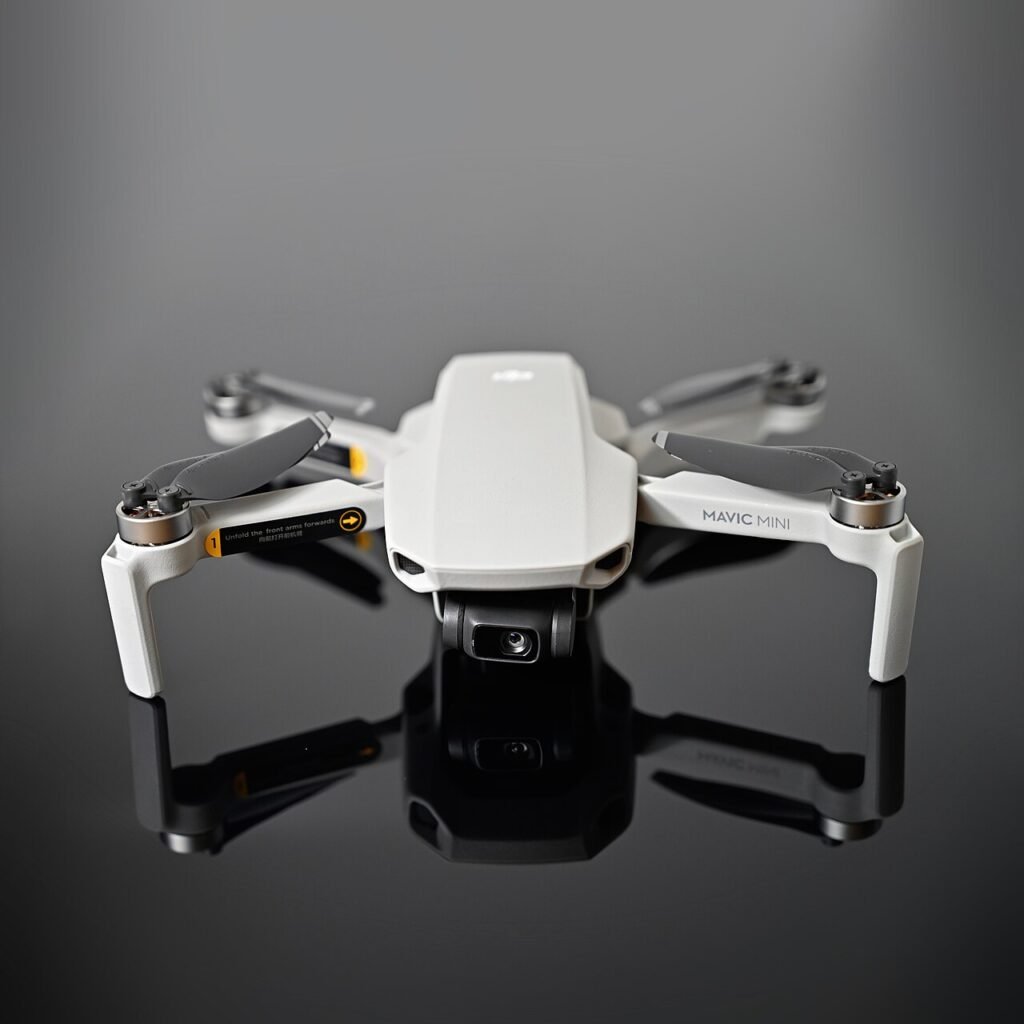
DJI Mavic Mini
Explore the available technical information for this aircraft, including camera capabilities, flight performance and manufacturer-specific specifications.
The DJI Mavic Mini is an early lightweight folding camera drone built around a 249 g takeoff weight. It was designed to make aerial photography more portable while retaining a 3-axis mechanical gimbal and GPS-assisted flight. This model is now a legacy product, so buyers should assess battery condition, controller compatibility and repair support before purchasing a used unit.
Key specifications
- Takeoff weight: 249 g (standard configuration)
- Maximum flight time: 30 minutes in DJI’s stated no-wind test
- Camera: 1/2.3-inch CMOS, 12 MP
- Maximum video: 2.7K at 24/25/30 fps; Full HD up to 60 fps
- Gimbal: 3-axis mechanical stabilisation
- Maximum speed: 13 m/s in S mode, near sea level and without wind
- Satellite systems: GPS and GLONASS
- Maximum wind resistance: 8 m/s (Level 4)
Camera and stabilisation
The Mavic Mini’s 12 MP camera uses a 1/2.3-inch sensor and records up to 2.7K video. Its 3-axis gimbal is an important advantage over very small drones that rely only on electronic stabilisation. It is suitable for daylight photos and simple travel footage, but it lacks 4K recording, RAW photo capture and the advanced tracking features found on newer models.
Flight and safety
DJI’s 30-minute maximum flight-time figure comes from a controlled test at a steady speed in windless conditions. Actual flight time will be lower and depends on wind, temperature, battery age and flying style. The aircraft has downward vision positioning for hovering in suitable conditions, but it does not have forward or omnidirectional obstacle avoidance. Pilots must keep the flight path clear and use Return-to-Home with a suitable altitude set.
Used-buying advice
Before buying, inspect the battery for swelling or damage, check that all motors start smoothly, test the gimbal and camera, verify GPS lock, and confirm that the remote controller and DJI Fly app work with your phone. Check the exact battery version and regional model because specifications and radio rules can vary. A low purchase price may not be attractive if replacement batteries or repairs are difficult to obtain.
Who should consider it?
The Mavic Mini may suit a beginner who wants an inexpensive used drone for basic daylight photography, or an existing owner who needs a compatible replacement. Buyers who need 4K video, obstacle avoidance, longer practical flight sessions or current manufacturer support should compare newer Mini-series models instead.
This overview is based on DJI’s published documentation, not an independent flight test. Flight performance and regulatory requirements vary by region and operating conditions.
Official reference: DJI Mavic Mini specifications and support.
Drone Specifications
| Brand | DJI |
|---|---|
| Camera | 1/2.3-inch CMOS, 12 MP; 2.7K video up to 30 fps |
| Maximum Flight Time (minutes) | 30 min (manufacturer test at 14 km/h, windless) minutes |
| Maximum Transmission Range (km) | 4 km |
| Weight (g) | 249 g |
| Battery Capacity (mAh) | 2400 mAh |
| Obstacle Sensing | Downward vision positioning; no forward/rear obstacle avoidance |
| Positioning / GPS | GPS + GLONASS |
| Maximum Speed (m/s) | 13 m/s |
Additional Notes
Mavic Mini: 249 g; folded 140 × 82 × 57 mm; unfolded 160 × 202 × 55 mm. Max ascent 4 m/s, descent 3 m/s. Max flight distance 15.7 km in controlled conditions. Transmission range up to 4 km FCC / 2 km CE under unobstructed conditions. 3-axis mechanical gimbal.
Specification source: Official source
Official Price (USD)
No public USD price was verified on the manufacturer’s official store during this check.
For enterprise or discontinued models, contact the manufacturer for a current quotation. We do not substitute third-party seller prices.
Price checked: 2026-11-07


Aircraft & Flight
| Maximum horizontal speed | 13 m/s S; 8 m/s P; 4 m/s C |
|---|
Navigation & Obstacle Sensing
| Supported GNSS systems | GPS + GLONASS |
|---|
Operating Conditions & Dimensions
| Maximum wind resistance | 8 m/s (Scale 4) |
|---|
MANUFACTURER DATA
Detailed official specifications
Technical figures below are transcribed from the manufacturer documentation linked with this profile. Test figures are maximum or controlled-condition ratings where stated; actual performance varies by configuration and operating conditions. A field is omitted when the cited source does not publish a reliable value.
| Aircraft — Takeoff Weight [1] | 249 g |
|---|---|
| Aircraft — Dimensions | Folded: 140×81×57 mm (L×W×H); Unfolded: 159×202×55 mm (L×W×H); Unfolded (with propellers): 245×289×55 mm (L×W×H) |
| Aircraft — Diagonal Distance | 213 mm |
| Aircraft — Max Ascent Speed | 4 m/s (S Mode); 2 m/s (P Mode); 1.5 m/s (C Mode) |
| Aircraft — Max Descent Speed | 3 m/s (S Mode); 1.8 m/s (P Mode); 1 m/s (C Mode) |
| Aircraft — Max Speed (near sea level, no wind) | 13 m/s (S Mode); 8 m/s (P Mode); 4 m/s (C Mode) |
| Aircraft — Maximum Takeoff Altitude | 3000 m |
| Aircraft — Max Flight Time | 30 minutes (measured while flying at 14 kph in windless conditions) |
| Aircraft — Max Wind Speed Resistance | 8 m/s (Scale 4) |
| Aircraft — Max Pitch Angle | 30° (S Mode) ; 20° (P Mode); 20° (C Mode) |
| Aircraft — Max Angular Velocity | 150°/s (S Mode); 130°/s (P Mode); 30°/s (C Mode) |
| Aircraft — Operating Temperature Range | 0° to 40°C (32° to 104°F) |
| Aircraft — Operating Frequency[2] | Model MT1SS5: 5.725-5.850 GHz; Model MT1SD25: 2.400-2.4835 GHz, 5.725-5.850 GHz |
| Aircraft — Transmission Power (EIRP) | Model MT1SS5; 5.8 GHz: <30 dBm (FCC); <28 dBm (SRRC); Model MT1SD25; 2.4 GHz: <19 dBm (MIC/CE); 5.8 GHz: <14 dBm (CE) |
| Aircraft — GNSS | GPS+GLONASS |
| Aircraft — Hovering Accuracy Range | Vertical: ±0.1 m (with Vision Positioning), ±0.5 m (with GPS Positioning) ; Horizontal: ±0.3 m (with Vision Positioning), ±1.5 m (with GPS Positioning) |
| Gimbal — Mechanical Range | Tilt: -110° to 35° ; Roll: -35° to 35° ; Pan: -20° to 20° |
| Gimbal — Controllable Range | Tilt: -90° to 0° (default setting) -90° to +20° (extended) |
| Gimbal — Stabilization | 3-axis (tilt, roll, pan) |
| Gimbal — Max Control Speed (tilt) | 120°/s |
| Gimbal — Angular Vibration Range | ±0.01° |
| Sensing System — Downward | Operating Range: 0.5-10 m |
| Sensing System — Operating Environment | Non-reflective, discernable surfaces; Diffuse reflectivity (>20%); Adequate lighting (lux>15) |
| Camera — Sensor | 1/2.3” CMOS; Effective Pixels: 12 MP |
| Camera — Lens | FOV: 83°; 35 mm Format Equivalent: 24 mm; Aperture: f/2.8; Shooting Range: 1 m to ∞ |
| Camera — ISO Range | Video: ; 100-3200 (Auto); 100-3200 (Manual) ; Photo: ; 100-1600 (Auto); 100-3200 (Manual) |
| Camera — Shutter Speed | Electronic Shutter: 4-1/8000s |
| Camera — Still Image Size | 4:3: 4000×3000; 16:9: 4000×2250 |
| Camera — Still Photography Modes | Single shot; Interval: 2/3/5/7/10/15/20/30/60 s |
| Camera — Video Resolution | 2.7K:2720×1530 24/25/30 p; FHD:1920×1080 24/25/30/48/50/60 p |
| Camera — Max Video Bitrate | 40 Mbps |
| Camera — Supported File System | FAT32(≤32 GB); exFAT(>32 GB) |
| Camera — Photo Format | JPEG |
| Camera — Video Format | MP4 (H.264/MPEG-4 AVC) |
| Remote Controller & Video Transmission — Operating Frequency | Model MR1SS5: 5.725-5.850 GHz; Model MR1SD25: 2.400-2.4835 GHz, 5.725-5.850 GHz |
| Remote Controller & Video Transmission — Max Transmission Distance (unobstructed, free of interference) | Model MR1SS5; 5.8 GHz: 4000 m (FCC); 2500 m (SRRC); Model MR1SD25; 2.4 GHz: 2000 m (MIC/CE); 5.8 GHz: 500 m (CE) |
| Remote Controller & Video Transmission — Operating Temperature Range | 0° to 40°C (32° to 104°F) |
| Remote Controller & Video Transmission — Transmission Power (EIRP) | Model MR1SS5; 5.8 GHz: <30 dBm (FCC); <28 dBm (SRRC); Model MR1SD25; 2.4 GHz: <19 dBm (MIC/CE); 5.8 GHz: <14 dBm (CE) |
| Remote Controller & Video Transmission — Battery Capacity | 2600 mAh |
| Remote Controller & Video Transmission — Operating Current/Voltage | 1200 mA 3.6 V (Android); 450 mA 3.6 V (iOS) |
| Remote Controller & Video Transmission — Supported Mobile Device Size | Max length: 160 mm ; Max thickness: 6.5-8.5 mm |
| Remote Controller & Video Transmission — Supported USB Port Types | Lightning, Micro USB (Type-B), USB Type-C |
| Remote Controller & Video Transmission — Video Transmission System | Enhanced Wi-Fi |
| Remote Controller & Video Transmission — Live View Quality | 720p/30fps |
| Remote Controller & Video Transmission — Max. Bitrate | 4 Mbps |
| Remote Controller & Video Transmission — Latency (depending on environmental conditions and mobile device) | 170-240 ms |
| Charger — Input | 100-240 V, 50/60 Hz, 0.5A |
| Charger — Output | 12V 1.5 A / 9V 2A / 5V 3A |
| Charger — Rated Power | 18 W |
| Intelligent Flight Battery — Capacity | 2400 mAh |
| Intelligent Flight Battery — Voltage | 7.2 V |
| Intelligent Flight Battery — Max Charging Voltage | 8.4 V |
| Intelligent Flight Battery — Battery Type | Li-ion 2S |
| Intelligent Flight Battery — Energy | 17.28 Wh |
| Intelligent Flight Battery — Net Weight | 100 g |
| Intelligent Flight Battery — Charging Temperature Range | 5° to 40°C (41° to 104°F) |
| Intelligent Flight Battery — Max Charging Power | 24 W |
| Intelligent Flight Battery (1100 mAh) — Capacity | 1100 mAh |
| Intelligent Flight Battery (1100 mAh) — Voltage | 7.6 V |
| Intelligent Flight Battery (1100 mAh) — Max Charging Voltage | 8.7 V |
| Intelligent Flight Battery (1100 mAh) — Battery Type | LiPo 2S |
| Intelligent Flight Battery (1100 mAh) — Energy | 8.36 Wh |
| Intelligent Flight Battery (1100 mAh) — Net Weight | 50 g |
| Intelligent Flight Battery (1100 mAh) — Charging Temperature Range | 5° to 40°C (41° to 104°F) |
| Intelligent Flight Battery (1100 mAh) — Max Charging Power | 18 W |
| APP — Name | DJI Fly |
| APP — Required Operating System | iOS v10.0 or later Android v6.0 or later |
| Supported SD Cards — Supported SD Cards | UHS-I Speed Class 3 or above is required. A list of reccomended microSD cards can be found below. |
| Supported SD Cards — Recommended microSD Cards | 16 GB: SanDisk Extreme, Lexar 633x; 32 GB: Samsung Pro Endurance, Samsung Evo Plus, SanDisk Industrial, Sandisk Extreme V30 A1, SanDisk Extreme V30 A2, SanDisk Extreme Pro V30 A1, SanDisk Extreme Pro V30 A2, Lexar 633x, Lexar 667x; 64 GB: Samsung Pro Endurance, Samsung Evo Plus, SanDisk Extreme V30 A2, Lexar 633x, Lexar 667x, Lexar 1000x, Lexar High Endurance, Toshiba EXCERIA M303 V30 A1, Netac Pro V30 A1; 128 GB: Samsung Evo Plus, SanDisk Extreme V30 A2, SanDisk Extreme Plus V30 A1, SanDisk Extreme Plus V30 A2, Lexar 633x, Lexar 667x, Lexar 1000x, Lexar High Endurance, Toshiba EXCERIA M303 V30 A1, Netac Pro V30 A1; 256 GB: SanDisk Extreme V30 A2 |
| Footnotes — Footnotes | 1. Aircraft takeoff weight (includes battery, propellers, and a microSD card). Registration not required in some countries and regions. Check local rules and regulations before use.These specs have been determined through tests conducted with the latest firmware. Firmware updates can enhance performance, so updating to the latest firmware is highly recommended.; 2. Due to local policy and regulation restrictions, the 5.8 GHz frequency band is currently banned in certain countries, including but not limited to Japan, Russia, Israel, Ukraine, and Kazakhstan. Please use the 2.4 GHz frequency band when operating in these locations. Always check local rules and regulations before use, as they may change over time. |
Source: manufacturer technical specifications and official support documentation. Regional versions, payloads, batteries, firmware and test conditions can change the stated figures. Check the linked source for the applicable configuration.