
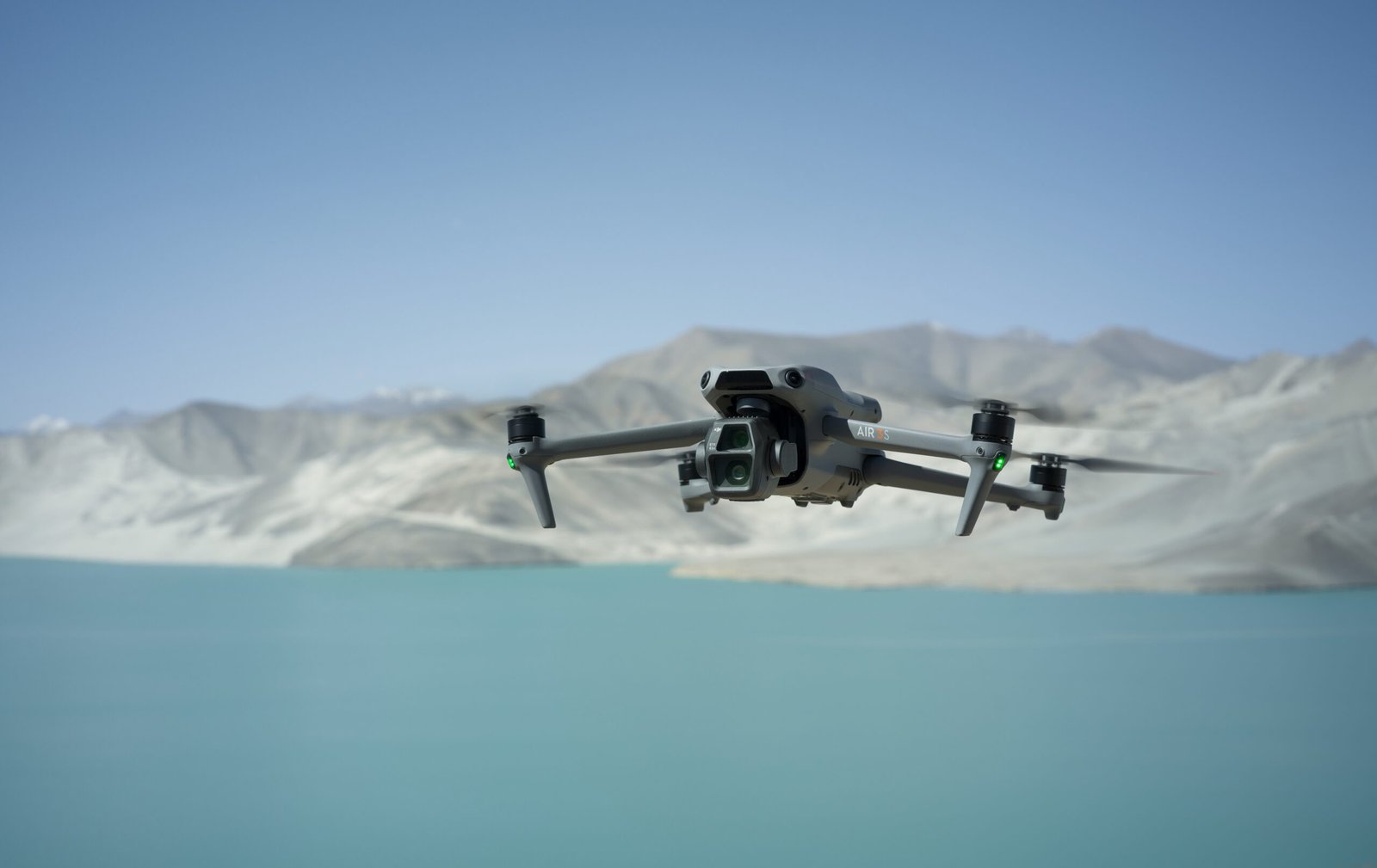

The DJI Air 3S is a dual-camera travel drone with a 1-inch primary camera and a 70 mm medium-tele perspective. This research-based review uses DJI’s published documentation and is not a hands-on test.
At a glance
- Takeoff weight: approximately 724 g.
- Maximum flight time: up to 45 minutes in DJI’s controlled test.
- Wide camera: 1-inch CMOS, 50 MP, 24 mm equivalent, f/1.8.
- Medium-tele camera: 1/1.3-inch CMOS, 48 MP, 70 mm equivalent, f/2.8.
- Video: up to 4K/60 fps HDR and 4K/120 fps in supported slow-motion modes.
- Internal storage: 42 GB; DJI O4 transmission.
- Obstacle sensing: omnidirectional vision with forward LiDAR and downward infrared sensing.
Dual-camera imaging
The 1-inch main camera is designed for landscapes, architecture and low-light scenes. The 70 mm medium-tele camera offers tighter framing for portraits, vehicles and layered compositions. The sensors and lenses differ, so do not assume identical image quality or recording options. Check supported codecs, frame rates and colour modes for the intended production.
Nightscape sensing
DJI describes omnidirectional sensing supplemented by forward-facing LiDAR and a downward infrared sensor. This can improve obstacle awareness in supported low-light scenarios, but it does not make night flights automatically safe or legal. Follow local night-operation rules and maintain pilot oversight.
Specifications
| Specification | Published value |
|---|---|
| Takeoff weight | Approx. 724 g |
| Maximum flight time | 45 minutes |
| Maximum flight distance | 32 km (test figure) |
| Maximum horizontal speed | 21 m/s; 19 m/s in EU region |
| Maximum takeoff altitude | 6,000 m |
| Wind resistance | 12 m/s |
| Operating temperature | -10°C to 40°C |
| Navigation | GPS, Galileo and BeiDou |
| Internal storage | 42 GB |
| Maximum hovering time | 41 minutes (controlled DJI test) |
| EU class | C1 |
Maximum time and distance are controlled test results, not mission guarantees.
Air 3S vs Air 3
Air 3S upgrades the main camera to a 1-inch 50 MP sensor, adds forward LiDAR and increases internal storage to 42 GB. Air 3 uses two 1/1.3-inch 48 MP cameras, 8 GB internal storage and a 46-minute published maximum. Air 3 remains sensible if its camera output meets your needs.
Verdict
Air 3S suits creators who want wide and medium-tele framing, a larger primary sensor and newer sensing hardware. Compare camera modes, battery bundles, weight, local rules and total cost before choosing it over Air 3.
Primary source: DJI Air 3S official specifications. Related: DJI Air 3 overview.
Camera and flight figures in context
DJI lists a maximum flight time of 45 minutes and a maximum hovering time of 41 minutes, each measured under separate controlled conditions. Its published 32 km maximum flight distance is likewise a test figure, not a safe route-planning target. The wide camera is a 1-inch 50 MP unit with a 24 mm-equivalent f/1.8 lens; the medium-tele camera is a 1/1.3-inch 48 MP unit with a 70 mm-equivalent f/2.8 lens. The C1 marking applies in the EU; check the aircraft marking and national rules for the exact market version.
Is the Air 3S a good travel photography drone?
The Air 3S is aimed at travellers and aerial creators who want two useful perspectives in one aircraft. The 24 mm-equivalent wide camera is suited to coastlines, cityscapes, architecture and broad establishing shots. The 70 mm-equivalent medium-tele camera offers tighter compositions for mountain layers, distant buildings and subjects that should not be approached closely. This second viewpoint can make a travel film feel more varied, but it does not turn the aircraft into a long-range optical-zoom system.
At approximately 724 g, the Air 3S is not an ultra-light sub-250 g drone. The complete travel kit—controller, batteries, charging hub, filters and case—takes meaningful luggage space. Buyers should compare the weight of the entire kit and check airline battery rules, not just the aircraft’s folded dimensions.
Low-light camera strengths and limitations
The 1-inch main sensor and f/1.8 lens give the wide camera a useful hardware advantage for dusk scenes and dimmer environments compared with many smaller-sensor drone cameras. That does not mean every night scene will be clean. Raising ISO can introduce noise; longer exposures can show motion blur from aircraft movement; bright signs and streetlights can clip highlights; and haze or humidity can reduce contrast. The medium-tele camera has a different, smaller sensor and f/2.8 lens, so buyers should not expect it to behave like the main camera in difficult light.
- Use the main camera when light is limited and the scene permits a wider composition.
- Keep shutter speed appropriate for aircraft and subject movement; a tripod-like hovering drone is not perfectly motionless.
- Capture a test clip and inspect shadows, highlights and fine detail before relying on a setting for a full shoot.
- Use ND filters primarily to manage exposure in bright conditions, not as a universal low-light accessory.
- Respect night-flight rules and avoid assuming obstacle sensors make an unlit flight safe.
Air 3S versus Air 3 and Mavic 4 Pro
Choose Air 3S over Air 3 if the larger 1-inch main camera, forward LiDAR/low-light sensing features and additional internal storage address a real need. The Air 3 remains a rational value choice if its dual-camera output is sufficient and it is available at a materially lower total price. Compare actual recording modes, batteries and bundle contents before deciding.
Choose Mavic 4 Pro if the three-camera system, flagship imaging options and more flexible focal-length selection are important to paid production. It is a larger investment and a heavier travel system. For many holiday and social-media creators, the Air 3S is likely to be the more balanced purchase.
Consider a Mini-series model if low carry weight and a compact travel kit matter more than the Air 3S’s larger main sensor and medium-tele camera. Check the precise model’s camera system and local rules; do not generalise across the entire Mini range.
Real-world flight planning and limitations
DJI’s 45-minute maximum flight time and 32 km maximum flight distance are controlled manufacturer figures, not usable travel-shoot guarantees. Wind, cold, battery age, repeated acceleration, obstacle avoidance, filming and the return reserve all affect practical endurance. A sensible itinerary plans short shots, safe landing areas and a reserve rather than attempting to use the full published maximum.
The 724 g takeoff weight also has regulatory consequences. In some places the aircraft may fall into a category with registration, competency or operational restrictions that do not apply to lighter models. Crowded tourist areas, national parks, airports, border zones and private property can have additional restrictions even where general drone use is allowed.
Country-specific checks
India: check the DGCA Drone Rules and Digital Sky airspace map for the planned location. Confirm registration and remote-pilot requirements, airspace zone permissions and local restrictions. Do not assume that a tourist location is a permitted flight site.
United States: check FAA registration, Remote ID and airspace requirements. Recreational flyers and Part 107 operators have different obligations; obtain required authorisations before operating in controlled airspace.
European Union: verify the aircraft’s C1 class status and the applicable Open-category subcategory, pilot competency, operator registration and geo-zone restrictions. National parks and local authorities may impose additional restrictions.
Always verify current rules with the relevant aviation authority. This summary is general information, not legal advice.
Travel buyer checklist
- Choose the bundle based on the number of batteries and controller included, not just the advertised starting price.
- Check airline rules for battery capacity, carry-on quantity and terminal protection.
- Budget for a fast memory card, spare storage, filters and a reliable backup workflow.
- Check local service, warranty, app and firmware support before travelling.
- Research destination rules, no-fly zones, privacy restrictions and permissions for commercial work.
This is an editorial review based on DJI documentation and research. IGIDRONE has not performed a hands-on flight or low-light camera test for this article. Low-light observations explain the implications of the published sensor and lens specifications; they are not measured test results.