
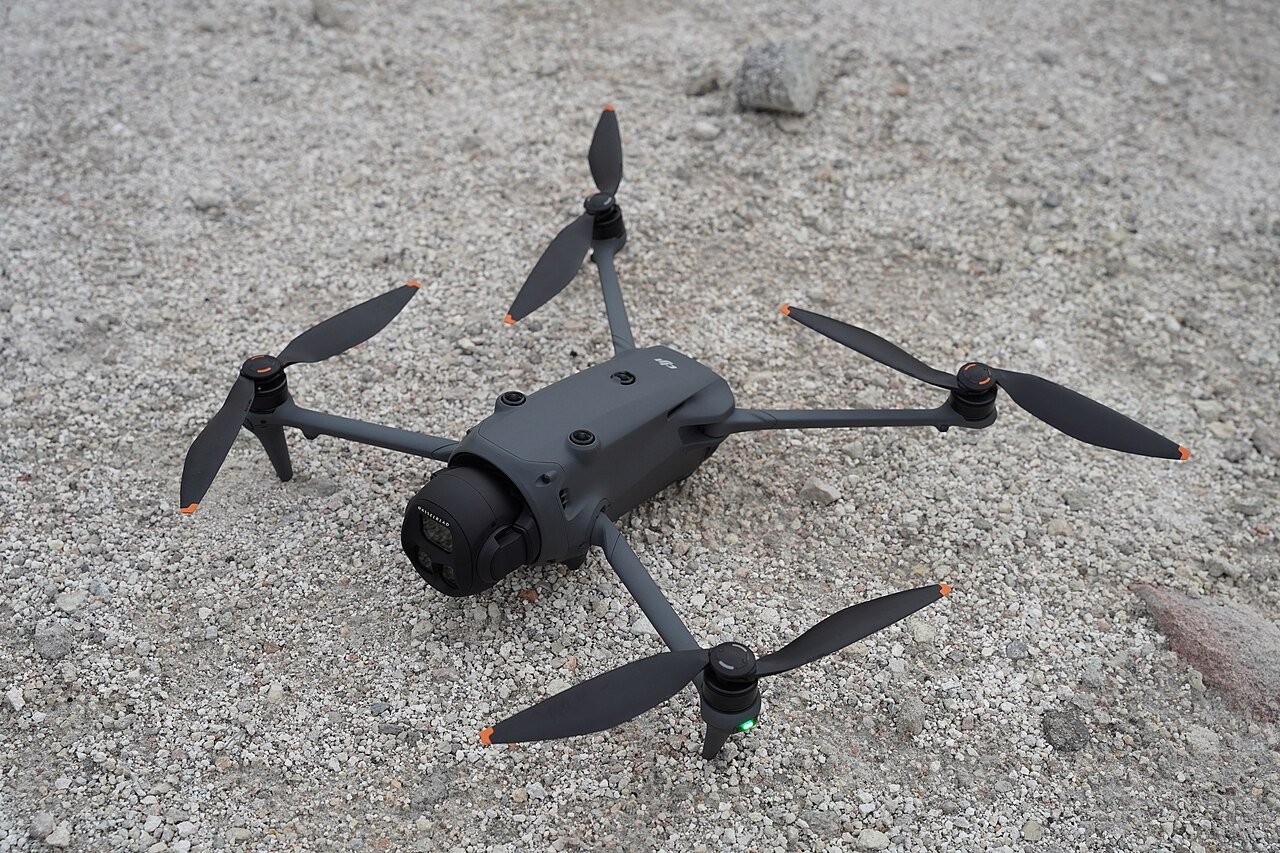
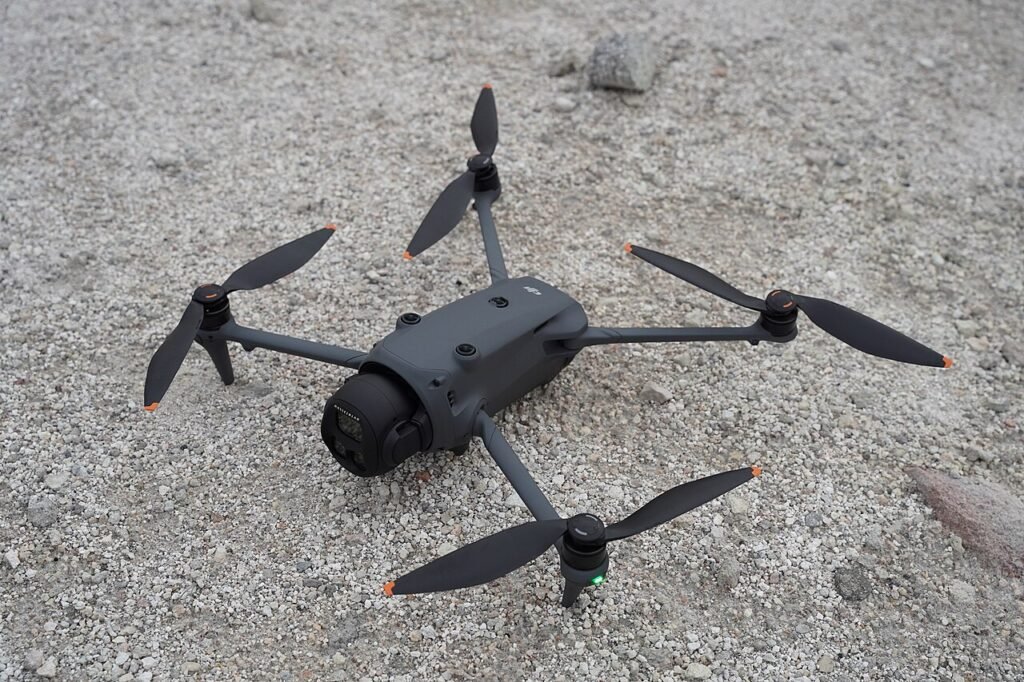
The DJI Mavic 4 Pro is a flagship folding camera drone with a three-camera imaging system, rotating gimbal and advanced obstacle sensing. This research-based overview uses DJI’s published specifications and is not a hands-on flight test.
At a glance
- Takeoff weight: approximately 1,063 g.
- Maximum flight time: up to 51 minutes under DJI test conditions.
- Maximum flight distance: up to 41 km under specified conditions.
- Three-camera system led by a 4/3 CMOS Hasselblad main camera.
- Maximum takeoff altitude: 6,000 m; 3,000 m with propeller guards.
- DJI O4+ transmission.
Camera system
The Mavic 4 Pro combines a 4/3 CMOS Hasselblad main camera with medium-tele and telephoto cameras. Different focal lengths support landscapes, architecture, portraits and distant subjects without repositioning the aircraft as often. Sensor size, aperture, focal length and recording modes differ by camera; check DJI’s camera-mode table before planning a production.
Flight time and practical endurance
DJI’s 51-minute figure is a controlled manufacturer test, not a typical filming-session promise. Wind, temperature, battery condition, flight speed, camera use and return reserve reduce practical mission time. The approximately 1,063 g weight also matters when checking local registration and operating categories.
Specifications
| Specification | Published value |
|---|---|
| Takeoff weight | Approx. 1,063 g |
| Maximum flight time | 51 minutes |
| Maximum flight distance | 41 km |
| Maximum takeoff altitude | 6,000 m (3,000 m with propeller guards) |
| Maximum horizontal speed | 25 m/s in Sport mode, controlled conditions |
| Wind resistance | 12 m/s |
| Operating temperature | -10°C to 40°C |
| Navigation | GPS, Galileo and BeiDou |
| Internal storage | 64 GB total (about 42 GB available); 512 GB Creator Combo version (about 460 GB available) |
| EU class | C2 |
| Transmission | DJI O4+ |
Who should consider it?
Professional creators may benefit from multi-camera flexibility. Travel filmmakers may value the folding design, while inspection teams should assess resolving detail, permissions and workflow. Casual pilots may find an Air-series model sufficient.
Mavic 4 Pro vs Mavic 3 Pro
Compare camera performance, gimbal movement, obstacle sensing, transmission, storage, controller compatibility and battery ecosystem. The Mavic 3 Pro may remain suitable where its triple-camera system already meets the production need.
Buying checklist
- Confirm regional aircraft and controller bundle.
- Check firmware, app and controller compatibility.
- Compare camera modes, not megapixel counts alone.
- Budget for batteries, charging, filters, storage and insurance.
- Review local registration, airspace and privacy requirements.
Verdict
The Mavic 4 Pro is a high-end multi-camera platform for users who will use its imaging flexibility. Its headline endurance and weight are manufacturer specifications, not real-world guarantees.
Primary source: DJI Mavic 4 Pro official specifications. Related: Mavic 3 Pro review.
Camera specifications buyers should compare
The three cameras have different sensor sizes and focal lengths: the Hasselblad main camera uses a 4/3-inch 100 MP sensor and a 28 mm-equivalent f/2.0–f/11 lens; the medium-tele camera uses a 1/1.3-inch 48 MP sensor at 70 mm equivalent and f/2.8; and the tele camera uses a 1/1.5-inch 50 MP sensor at 168 mm equivalent and f/2.8. These differences matter more than comparing megapixel counts alone. The published maximum hovering time is 45 minutes, while the 51-minute maximum flight-time figure is measured under DJI’s controlled test conditions.
Who is the Mavic 4 Pro really for?
The Mavic 4 Pro makes the most sense for photographers and production teams who will deliberately use more than one focal length. The main Hasselblad camera is the natural choice for wide establishing shots, landscapes and general-purpose aerial footage. The medium-tele and tele cameras can help isolate buildings, boats, vehicles and distant landscape details while keeping the aircraft farther from a subject. That flexibility is valuable on a planned shoot, but it does not automatically improve every image: each camera has its own sensor, lens, aperture and recording constraints, so the operator must choose the right camera and exposure for the scene.
For a solo travel creator who mostly records wide scenic footage, the additional cameras may spend much of the flight unused. In that case, a less expensive Air-series drone may leave more budget for batteries, ND filters, storage and travel. For a professional who needs multiple perspectives in one compact aircraft, the Mavic 4 Pro’s camera arrangement can reduce the need to change aircraft or reposition as often.
Camera trade-offs buyers should understand
- Different cameras are not interchangeable: do not assume that the tele cameras match the main camera’s low-light performance, dynamic range, colour response or frame-rate options.
- Longer focal lengths magnify movement: wind, aircraft drift and subject motion can be more noticeable in tighter framing. Use appropriate shutter speed and conservative flight positions.
- Sensor size is only one factor: lens aperture, exposure, processing, bitrate, colour profile and the intended output all affect image quality.
- Gimbal rotation is a creative tool, not a substitute for planning: check framing, horizon behaviour and crop requirements for the delivery platform.
- Storage matters: high-resolution and high-bitrate footage quickly consumes cards and internal storage. Plan a verified offload and backup workflow.
Travel and portability trade-offs
Although it folds, the Mavic 4 Pro is a relatively substantial camera drone at approximately 1,063 g. Add the controller, batteries, charging equipment, filters and protective case and the travel kit becomes much larger than the aircraft alone suggests. Before flying internationally, check airline rules for lithium batteries, the battery’s watt-hour rating and the carrier’s carry-on requirements. Also check whether the destination requires registration, operator competency, insurance, remote identification or advance flight authorisation. A destination’s general permission to own a drone does not mean every location or flight is allowed.
Alternatives and when to choose them
DJI Air 3S: a more travel-oriented choice for creators who want a capable wide camera plus a medium-tele perspective without paying for the flagship platform. Its 1-inch main camera is a strong reason to consider it, but its cameras and creative flexibility are not identical to the Mavic 4 Pro.
DJI Mavic 3 Pro: worth comparing when its triple-camera system, image output and used or remaining-stock price meet the project. Check current firmware, battery health, controller compatibility, service and warranty rather than relying on a headline discount.
DJI Mini series: better suited to buyers who prioritise a lighter kit and simple travel photography. A lighter aircraft can have different regulatory treatment in some jurisdictions, but weight alone does not remove all operating restrictions.
Regional rules and purchase checks
India: check the current DGCA Drone Rules and Digital Sky airspace map. At approximately 1,063 g, this aircraft is not in the sub-250 g category; confirm the applicable registration, remote pilot, airspace and operational requirements for the exact aircraft and use. Check green, yellow and red zones and any temporary restrictions before every flight.
United States: determine whether the flight is recreational or under Part 107. Registration, Remote ID, airspace authorisation and pilot requirements may apply. Commercial content creation generally requires the appropriate operating pathway.
European Union: verify the aircraft’s class marking and current EASA category requirements. Do not assume a legacy or newly purchased aircraft has the same privileges as a sub-250 g C0 model. Check operator registration, pilot competency, remote identification and national geo-zone restrictions.
These are general starting points, not legal advice. Rules and product classifications can change; verify with the aviation authority in the country where the flight will take place.
Buying checklist and editorial method
- Compare the actual camera modes and sample files from each camera, not only sensor megapixels.
- Confirm which bundle is sold in your country and what controller, batteries and charger are included.
- Budget for spare batteries, filters, storage, backup drives, insurance and repairs.
- Check local support, warranty terms, app compatibility and firmware status.
- Confirm travel battery transport rules and destination flight permissions before booking.
This is a research-based review using published manufacturer documentation and product comparisons. IGIDRONE has not conducted a hands-on flight test for this article. The buyer recommendations are editorial analysis, not claims of personal piloting or measured test results.