

DJI / DRONE PROFILE
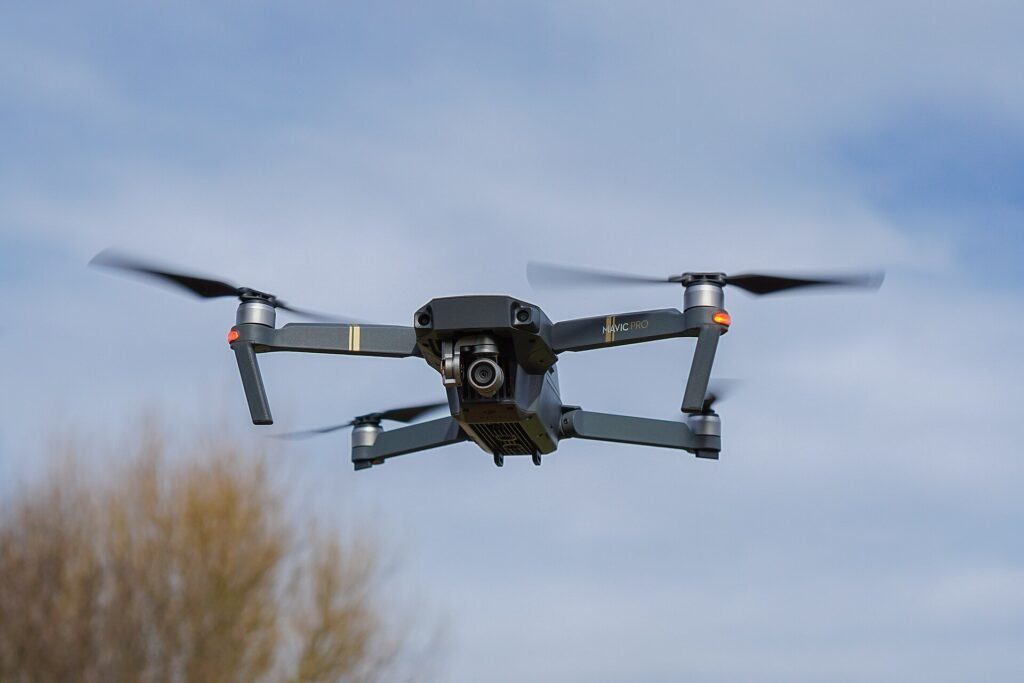
DJI Mavic Pro
Explore the available technical information for this aircraft, including camera capabilities, flight performance and manufacturer-specific specifications.
The original DJI Mavic Pro helped establish the folding camera-drone category by combining a portable airframe with a three-axis stabilised camera. It is an older model, but it remains relevant to buyers considering used equipment or comparing the evolution of DJI’s Mavic line.
Camera and flight platform
DJI’s published Mavic Pro specifications list a 1/2.3-inch CMOS camera with approximately 12 MP effective pixels, a 3-axis gimbal and GPS/GLONASS positioning. DJI lists up to 27 minutes maximum flight time under a specific no-wind test condition, and a maximum Sport-mode speed of 65 km/h under stated conditions. These are laboratory-style manufacturer figures, not expected results on every flight.
Portability and obstacle sensing
The folding arms make the Mavic Pro easier to pack than many earlier camera drones. Its forward and downward vision systems support obstacle awareness and positioning in suitable lighting and surface conditions. They do not provide the omnidirectional sensing available on newer aircraft, so pilots must maintain clearance and avoid relying on sensors in poor visibility.
Used-buying advice
Inspect battery cycles and swelling, gimbal movement, camera focus, arm hinges, motors and controller. Confirm that the aircraft can connect to the supported app and that firmware and phone compatibility meet your needs. Check spare-part availability and local aviation requirements before buying.
Official source: DJI Mavic Pro product specifications.
nn
Buying a used Mavic Pro in 2026
The original Mavic Pro is now a legacy aircraft, so condition and ecosystem support should carry more weight than headline specifications. Before purchase, test every battery under safe conditions, check for swelling or unusual voltage differences, inspect propeller arms and hinges, verify the gimbal completes its start-up calibration, and record sample photographs and video. Confirm that the remote controller, cables, charger and required mobile-device connection are included. App, firmware and phone compatibility can change over time, so verify the exact setup before paying.
Also consider whether the aircraft meets your current camera, safety and regulatory needs. Newer models may offer more capable sensing, imaging and transmission systems, while a well-maintained older Mavic Pro may still suit basic recreational use. Compare its age and feature set with the DJI Mavic 3 profile and Mavic 3 Classic profile rather than judging value from the original launch price.
Drone Specifications
| Brand | DJI |
|---|---|
| Camera | 1/2.3-inch CMOS, 12.35 MP; 4K video up to 30 fps |
| Maximum Flight Time (minutes) | 27 min (windless test at 25 km/h) minutes |
| Maximum Transmission Range (km) | 7 km |
| Weight (g) | 743 g |
| Battery Capacity (mAh) | 3830 mAh |
| Obstacle Sensing | Forward and downward vision positioning (model-specific) |
| Positioning / GPS | GPS + GLONASS |
| Maximum Speed (m/s) | 18 m/s |
Additional Notes
Mavic Pro: 743 g with gimbal cover; max takeoff weight and dimensions depend on propeller/guard configuration. Max flight time 27 min. Transmission range up to 7 km FCC / 4 km CE under unobstructed conditions. 3-axis gimbal.
Specification source: Official source
Official Price (USD)
No public USD price was verified on the manufacturer’s official store during this check.
For enterprise or discontinued models, contact the manufacturer for a current quotation. We do not substitute third-party seller prices.
Price checked: 2026-11-07


Aircraft & Flight
| Maximum horizontal speed | 65 km/h (Sport mode, no wind) |
|---|
Navigation & Obstacle Sensing
| Supported GNSS systems | GPS + GLONASS |
|---|
MANUFACTURER DATA
Detailed official specifications
Technical figures below are transcribed from the manufacturer documentation linked with this profile. Test figures are maximum or controlled-condition ratings where stated; actual performance varies by configuration and operating conditions. A field is omitted when the cited source does not publish a reliable value.
| Aircraft — Folded dimensions | 83 × 83 × 198 mm (H × W × L) |
|---|---|
| Aircraft — Diagonal size (propellers excluded) | 335 mm |
| Aircraft — Weight excluding gimbal cover | 734 g |
| Aircraft — Weight including gimbal cover | 743 g |
| Aircraft — Maximum ascent speed | 5 m/s (Sport mode) |
| Aircraft — Maximum descent speed | 3 m/s |
| Aircraft — Maximum speed | 65 km/h (Sport mode, no wind) |
| Aircraft — Maximum takeoff altitude | 5000 m |
| Aircraft — Maximum flight time | 27 min at constant 25 km/h in no wind |
| Aircraft — Maximum hovering time | 24 min in no wind |
| Aircraft — Typical overall flight time | Approx. 21 min with 15% battery remaining |
| Aircraft — Maximum total travel distance | 13 km in no wind |
| Aircraft — Operating temperature | 0°C to 40°C |
| Aircraft — Satellite positioning | GPS + GLONASS |
| Aircraft — Hovering accuracy vertical | ±0.1 m with Vision Positioning; ±0.5 m with GPS |
| Aircraft — Hovering accuracy horizontal | ±0.3 m with Vision Positioning; ±1.5 m with GPS |
| Aircraft — Operating frequency | FCC: 2.4–2.4835, 5.150–5.250 and 5.725–5.850 GHz; CE/SRRC: 2.4–2.4835 and 5.725–5.850 GHz |
| Aircraft — Transmitter power EIRP | 2.4 GHz: ≤26 dBm FCC; ≤20 dBm CE/SRRC; ≤18 dBm MIC. 5.2 GHz: ≤23 dBm FCC. 5.8 GHz: ≤23 dBm FCC; ≤13 dBm CE; ≤23 dBm SRRC |
| Remote controller — Operating frequency | 2.4–2.483 GHz |
| Remote controller — Maximum transmission distance | 7 km FCC; 4 km CE/SRRC/MIC (unobstructed, interference-free) |
| Remote controller — Operating temperature | 0°C to 40°C |
| Remote controller — Battery | 2970 mAh |
| Remote controller — Transmitter power EIRP | ≤26 dBm FCC; ≤20 dBm CE/SRRC; ≤18 dBm MIC |
| Remote controller — Operating current and voltage | 950 mA at 3.7 V |
| Remote controller — Supported mobile device size | 6.5–8.5 mm thick; maximum length 160 mm |
| Remote controller — Supported USB ports | Lightning, Micro USB Type-B and USB Type-C |
| Gimbal — Controllable range | Pitch -90° to +30°; roll 0° or 90° (horizontal/vertical) |
| Gimbal — Stabilization | 3-axis (pitch, roll, yaw) |
| Vision system — Sensors | Forward and downward vision systems |
| Vision system — Obstacle sensing range | Precision measurement 0.7–15 m; detectable range 15–30 m |
| Vision system — Operating environment | Clear patterns and adequate lighting above 15 lux |
| Vision system — Velocity range | Up to 36 km/h at 2 m above ground |
| Vision system — Altitude range | 0.3–13 m |
| Vision system — Operating range | 0.3–13 m |
| App and live view — Mobile app | DJI GO 4 |
| App and live view — Live view quality | 720p at 30 fps and 1080p at 30 fps (remote controller); 720p at 30 fps (Wi-Fi); 720p at 60 fps and 1080p at 30 fps (DJI Goggles) |
| App and live view — Latency | Approx. 160–170 ms, depending on conditions and mobile device |
| Camera — Sensor | 1/2.3-inch CMOS; 12.35 MP effective (12.71 MP total) |
| Camera — Lens | 78.8° FOV; 26 mm equivalent; f/2.2; distortion below 1.5%; focus 0.5 m to infinity |
| Camera — ISO range | Video 100–3200; photo 100–1600 |
| Camera — Electronic shutter speed | 8 s to 1/8000 s |
| Camera — Image size | 4000 × 3000 |
| Camera — Still photo modes | Single; burst 3/5/7; AEB 3/5 frames at 0.7 EV; interval |
| Camera — Video recording modes | C4K 4096 × 2160 24p; 4K 3840 × 2160 24/25/30p; 2.7K 2720 × 1530 24/25/30p; FHD up to 96p; HD up to 120p |
| Camera — Maximum video bitrate | 60 Mbps |
| Camera — Supported file systems | FAT32 up to 32 GB; exFAT above 32 GB |
| Camera — Photo formats | JPEG and DNG |
| Camera — Video formats | MP4 and MOV (MPEG-4 AVC/H.264) |
| Camera — Supported memory card | microSD up to 128 GB; Class 10 or UHS-I required |
| Camera — Operating temperature | 0°C to 40°C |
| Wi-Fi — Operating frequency | 2.4 GHz and 5 GHz |
| Wi-Fi — Maximum transmission distance | 80 m distance; 50 m height (unobstructed, interference-free) |
| Wi-Fi — Maximum speed | 14 km/h (9 mph) |
| Wi-Fi — Maximum ascent speed | 2 m/s |
| Wi-Fi — Maximum descent speed | 1 m/s |
| Charger — Voltage | 13.05 V |
| Charger — Rated power | 50 W |
| Intelligent flight battery — Capacity | 3830 mAh |
| Intelligent flight battery — Voltage | 11.4 V |
| Intelligent flight battery — Type | LiPo 3S |
| Intelligent flight battery — Energy | 43.6 Wh |
| Intelligent flight battery — Net weight | Approx. 240 g |
| Intelligent flight battery — Charging temperature | 5°C to 40°C |
| Intelligent flight battery — Maximum charging power | 100 W (battery); 50 W rated charger |
Source: manufacturer technical specifications and official support documentation. Regional versions, payloads, batteries, firmware and test conditions can change the stated figures. Check the linked source for the applicable configuration.