DJI / DRONE PROFILE
DJI Matrice 4E
Explore the available technical information for this aircraft, including camera capabilities, flight performance and manufacturer-specific specifications.
DJI Matrice 4E is part of DJI professional enterprise aircraft range. This profile summarises the manufacturer-published aircraft, camera or payload, sensing, endurance and communications data. Flight-time and distance figures are controlled-condition maxima and should not be treated as guaranteed mission endurance.
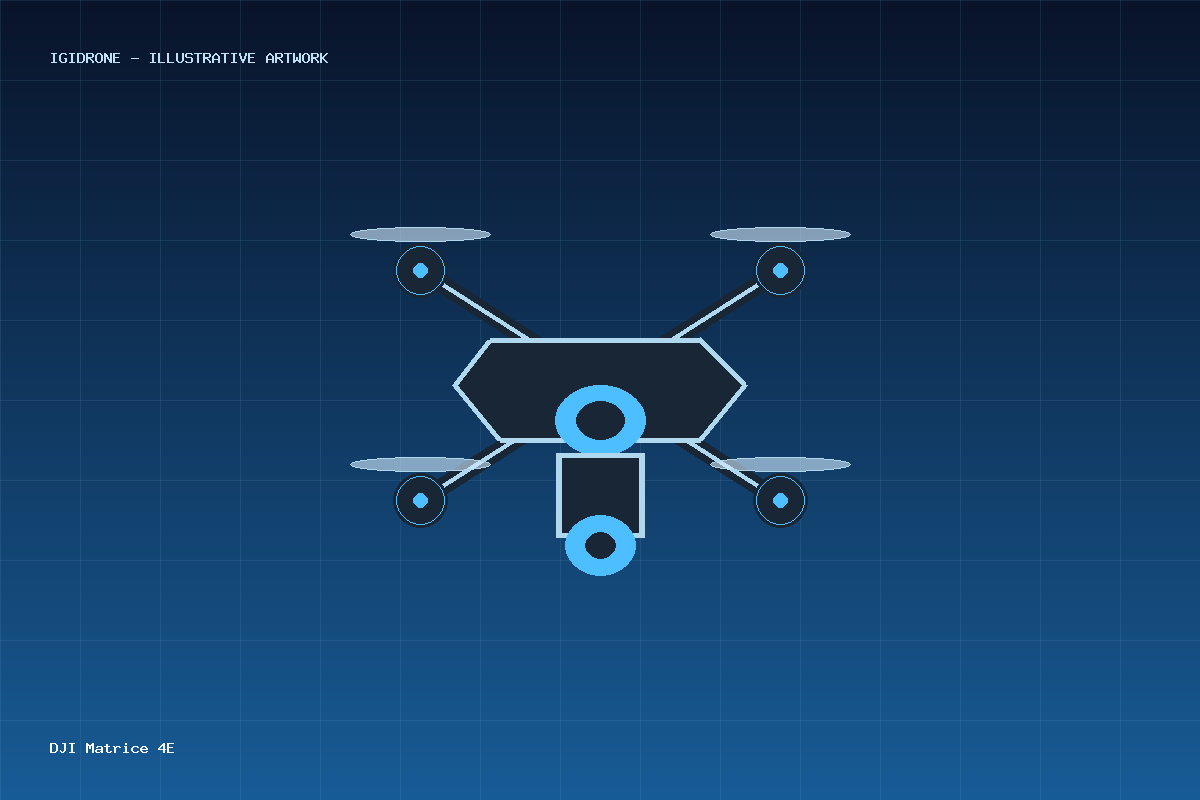
Featured image: original IGIDRONE illustrative artwork. It does not depict the exact DJI Matrice 4E aircraft.
Specifications and configuration notes
For the Matrice 4E, confirm the mapping camera configuration, mechanical-shutter workflow, firmware and supported survey software. The Matrice 4E is not interchangeable with the thermal Matrice 4T or dock-oriented 4D Series.
Manufacturer source: Official DJI documentation.
Imaging role: mapping and inspection
The Matrice 4E is the mapping-oriented member of DJI’s Matrice 4 series. DJI specifies a 4/3-inch 20 MP wide camera, plus 48 MP medium-tele and 48 MP tele cameras. The wide camera has a mechanical shutter, relevant to mapping workflows where rolling-shutter distortion can complicate image alignment. The three focal lengths let teams capture broad context and distant details without moving the aircraft unnecessarily.
Flight and workflow considerations
DJI lists a standard-propeller maximum flight time of 49 minutes in a no-wind test without payload. Treat this as a manufacturer test figure, not a survey duration. Battery reserve, wind, temperature, mapping speed, turns, altitude and image overlap all reduce productive sortie time.
Before buying, check DJI Pilot 2, mapping and processing software compatibility, RTK requirements, controller package, supported memory cards, image formats and local training and service. If survey accuracy matters, define ground sampling distance, overlap, coordinate reference system, ground-control strategy and quality-control process before selecting the aircraft.
Matrice 4E versus Matrice 4T
The 4E is the stronger fit when photogrammetry and visible-light mapping are the priority. The Matrice 4T adds a thermal camera and night-operation imaging features, but its wide camera sensor and lens differ. Choose based on the deliverable: orthomosaic accuracy, asset inspection, search support or thermal anomaly review. The 4E is not a substitute for a dedicated thermal payload.
Primary source: DJI Matrice 4 Series official specifications.
Who should consider DJI Matrice 4E?
This model should be evaluated as part of an enterprise workflow rather than by aircraft specifications alone. Start with the deliverable: visual inspection, thermal survey, mapping, public safety, asset documentation or remote operations. Define required image resolution, measurement confidence, coordinate reference system, data format, repeatability, turnaround and acceptance criteria. A sensor feature is valuable only if the organisation can use and interpret its output correctly. For DJI Matrice 4E, request written confirmation for the exact aircraft, payload, mount, firmware and software combination.
Limitations and trade-offs to understand
Thermal imagery does not automatically provide a certified temperature measurement. Results depend on emissivity, reflected temperature, distance, angle, atmospheric conditions, focus, calibration and operator interpretation. For mapping, RTK does not remove the need for sound flight planning, overlap, control strategy and quality assurance. Confirm the required accuracy using a representative project. For DJI Matrice 4E, validate representative mission data against the organisation’s accuracy and reporting requirements before fleet purchase.
Alternatives worth comparing
Compare the model with the DJI Matrice 4E for mapping-oriented work, Matrice 4T or 5T for thermal missions, Matrice 4D/4TD for dock-based workflows, and the Matrice 350 RTK or Matrice 400 for larger enterprise payload needs. These platforms have different payload and operating ecosystems; verify the exact model variant and compatibility. For DJI Matrice 4E, include service turnaround, spare batteries, training and data governance in the procurement comparison.
Pre-purchase and ownership checklist
Ask for a payload compatibility matrix, current user manual, firmware support statement, service-level commitment, battery replacement cost, cybersecurity documentation and a representative sample data set. Include operator training, insurance, maintenance, spare parts and software in the total-cost calculation. For DJI Matrice 4E, test the failsafe and communications-loss procedure at the intended operating site.
How to use this specification profile
This page is a research-based reference, not a claim that IGIDRONE has independently flight-tested the aircraft. Treat manufacturer maximums as test-condition figures and distinguish standard equipment from optional accessories or regional bundles. Before buying, compare the exact model code, firmware, battery, controller and payload configuration against the current official manual. If a field is marked unknown or is not documented by the manufacturer, do not infer a value from a similarly named variant. For DJI Matrice 4E, request written confirmation for the exact aircraft, payload, mount, firmware and software combination.
Primary manufacturer reference: Open the manufacturer specification or support page. Confirm the current regional documentation before purchase. For DJI Matrice 4E, validate representative mission data against the organisation’s accuracy and reporting requirements before fleet purchase.
Editorial update: 8 November 2026. Model availability, prices, software support and regional operating rules can change. Confirm them with the manufacturer, authorised distributor and relevant aviation authority before purchase or flight. For DJI Matrice 4E, include service turnaround, spare batteries, training and data governance in the procurement comparison.
Mission validation before fleet purchase
Run a proof-of-concept on a representative asset or survey site. Define the expected output in advance and have the end user assess the imagery or data, not only the pilot. For inspection, confirm that the camera can resolve the smallest feature the team must identify. For mapping, validate the processing workflow and coordinate system against known control points. For DJI Matrice 4E, request written confirmation for the exact aircraft, payload, mount, firmware and software combination.
Evidence to request from a supplier
Ask for current manuals, payload compatibility statements, sample data, firmware lifecycle information, repair turnaround, training requirements and cybersecurity documentation. If the supplier quotes mapping accuracy or thermal measurement performance, ask for the test conditions and method used to validate it. Obtain written confirmation of any payload or software dependency that is essential to the mission. For DJI Matrice 4E, validate representative mission data against the organisation’s accuracy and reporting requirements before fleet purchase.
Editorial standard: buyer guidance is based on published manufacturer information and practical ownership considerations. IGIDRONE does not claim independent flight testing unless a page explicitly documents a real test. For DJI Matrice 4E, include service turnaround, spare batteries, training and data governance in the procurement comparison.
Drone Specifications
| Brand | DJI |
|---|---|
| Camera | Wide 4/3-inch CMOS 20 MP with mechanical shutter; medium tele 1/1.3-inch CMOS 48 MP; tele 1/1.5-inch CMOS 48 MP |
| Maximum Flight Time (minutes) | 49 min standard propellers; 46 min low-noise propellers (no-wind test) minutes |
| Weight (g) | 1,219 g standard propellers; 1,229 g low-noise propellers g |
| Battery Capacity (mAh) | Matrice 4 Series battery, 6,768 mAh mAh |
| Wind Resistance (m/s) | 12 m/s during takeoff and landing m/s |
| Obstacle Sensing | Omnidirectional binocular vision with downward 3D infrared sensor |
| Positioning / GPS | GPS + Galileo + BeiDou; GLONASS with RTK module |
| Maximum Speed (m/s) | 21 m/s forward; 18 m/s backward; 19 m/s sideways m/s |
Additional Notes
Designed for mapping and geospatial work. DJI lists no standard IP protection rating for this model.
Specification source: Official source
Last verified: 2026-11-08
Official Price (USD)
No public USD price was verified on the manufacturer’s official store during this check.
For enterprise or discontinued models, contact the manufacturer for a current quotation. We do not substitute third-party seller prices.
MODEL TECHNICAL RECORD
Detailed Technical Specifications
Manufacturer-specific technical information recorded for this model. Values not present in the source record are not estimated.
Aircraft
| brand | DJI |
|---|---|
| weight | 1,219 g standard propellers; 1,229 g low-noise propellers |
| max_takeoff_weight | 1,420 g standard propellers; 1,430 g low-noise propellers |
| max_payload | 200 g |
| flight_time | 49 min standard propellers; 46 min low-noise propellers (no-wind test) |
| max_flight_distance | 35 km standard propellers; 32 km low-noise propellers (no-wind test) |
| max_speed | 21 m/s forward; 18 m/s backward; 19 m/s sideways |
| max_ascent_speed | 10 m/s |
| max_descent_speed | 8 m/s |
| wind_resistance | 12 m/s during takeoff and landing |
| max_takeoff_altitude | 6,000 m; 4,000 m with payload |
| gps | GPS + Galileo + BeiDou; GLONASS with RTK module |
| camera | Wide 4/3-inch CMOS 20 MP with mechanical shutter; medium tele 1/1.3-inch CMOS 48 MP; tele 1/1.5-inch CMOS 48 MP |
| laser_rangefinder | 1,800 m measurement range under stated test conditions |
| obstacle_sensing | Omnidirectional binocular vision with downward 3D infrared sensor |
| battery | Matrice 4 Series battery, 6,768 mAh |
| specification_source | Official DJI Matrice 4 Series specifications |
| notes | Designed for mapping and geospatial work. DJI lists no standard IP protection rating for this model. |


Aircraft & Flight
| Maximum takeoff altitude | 6,000 m; 4,000 m with payload |
|---|---|
| Maximum ascent speed | 10 m/s |
| Maximum descent speed | 8 m/s |
| Maximum flight distance | 35 km standard propellers; 32 km low-noise propellers (no-wind test) |
| Maximum takeoff weight | 1,420 g standard propellers; 1,430 g low-noise propellers |
MANUFACTURER DATA
Detailed official specifications
Technical figures below are transcribed from the manufacturer documentation linked with this profile. Test figures are maximum or controlled-condition ratings where stated; actual performance varies by configuration and operating conditions. A field is omitted when the cited source does not publish a reliable value.
Manufacturer source last checked: 2026-11-08
Evidence type: Official DJI manufacturer specifications and enterprise documentation
Source: manufacturer technical specifications and official support documentation. Regional versions, payloads, batteries, firmware and test conditions can change the stated figures. Check the linked source for the applicable configuration.
Related Dji drones
Explore other published models from the same manufacturer.