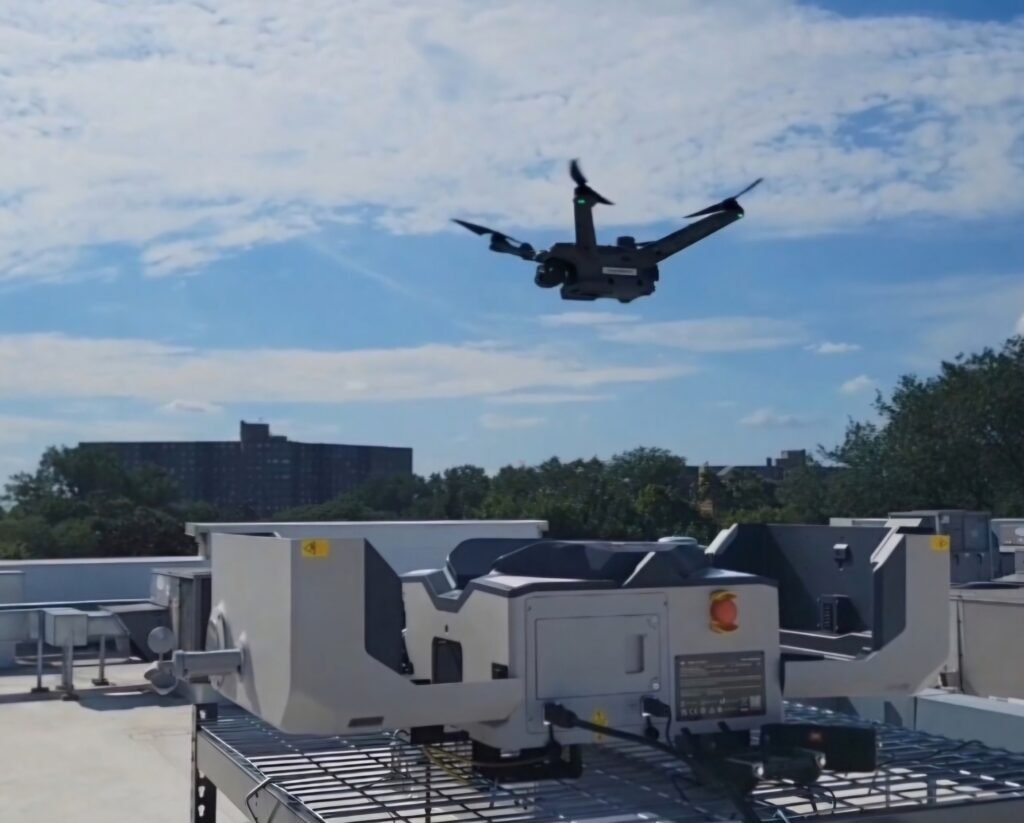
Photo: Chiam Naiditch · Licence: CC BY 4.0 · View the original source and licence terms.
DJI / DRONE PROFILE
DJI Matrice 3TD
Explore the available technical information for this aircraft, including camera capabilities, flight performance and manufacturer-specific specifications.
The DJI Matrice 3TD is an enterprise aircraft designed for automated visual and thermal inspection with DJI Dock 2. It is part of an integrated dock-based system intended for repeatable missions at a fixed site. The 3TD differs from the mapping-focused Matrice 3D through its camera package, which combines visible-light imaging with a thermal camera.
Visible and thermal imaging
DJI lists a 48 MP wide-angle camera with a 1/1.32-inch CMOS sensor and a 12 MP tele camera with a 1/2-inch CMOS sensor. The aircraft also includes a thermal camera with a 40 mm-equivalent lens. DJI specifies thermal video at 640 × 512 and 30 fps in normal mode, with a higher-resolution UHR infrared image mode available under supported conditions. Thermal output is affected by target emissivity, distance, atmospheric conditions and the selected measurement settings, so readings should be interpreted by appropriately trained staff.
Dock-based deployment
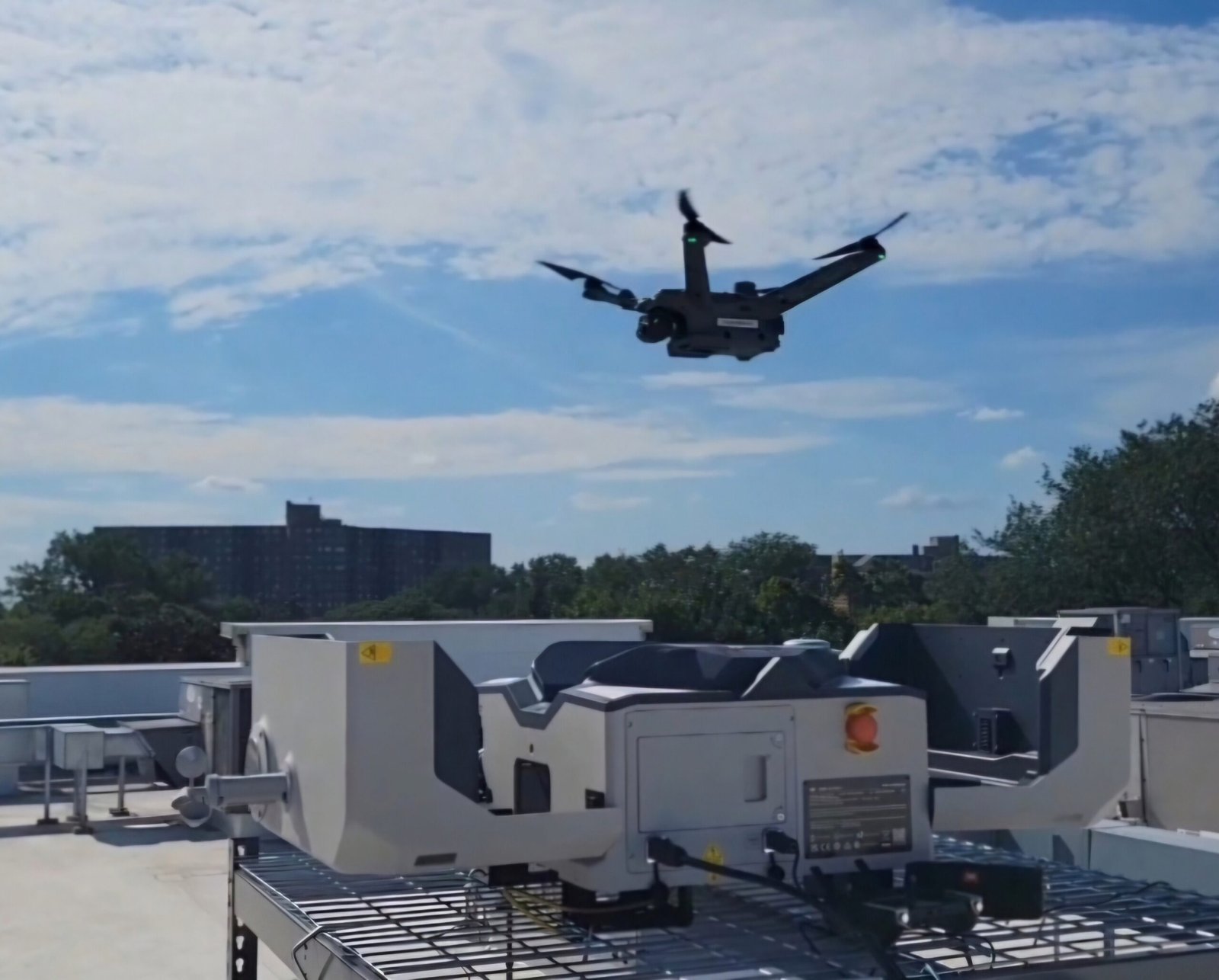
Used with DJI Dock 2, the Matrice 3TD supports scheduled and remote site operations. A reliable deployment requires suitable installation location, power, network connectivity, weather planning, maintenance access and a clear escalation process for faults or unexpected conditions. Remote mission capability does not remove the need for regulatory approval or operational supervision.
Choosing between Matrice 3D and 3TD
The Matrice 3TD is the more appropriate member of the pair when thermal and visual inspection are central to the job. The Matrice 3D is the mapping-oriented alternative with a 4/3-inch 20 MP wide camera and mechanical shutter. Confirm the exact aircraft, dock, software and region-specific operating permissions before buying.
Who should consider it?
Utilities, industrial sites and organisations with repeatable inspection routes may evaluate the Matrice 3TD where thermal information adds value. Assess the smallest defect or temperature difference that must be detected and verify whether the camera and working distance are adequate for that task.
Source: DJI Dock 2 and Matrice 3D/3TD official overview.
Dock 2 deployment considerations
The Matrice 3TD is designed for use within an automated Dock 2 workflow, so the aircraft should not be evaluated in isolation. A complete deployment depends on the dock, network connection, site preparation, charging and environmental conditions, flight-route design and the software used to monitor missions. The 3TD is the thermal-capable member of the Matrice 3D family; do not transfer its camera configuration to the Matrice 3D. For remote inspection, assess the entire system’s reliability, permissions and maintenance plan, not just the aircraft specifications. Confirm regional availability and the exact dock/aircraft bundle with DJI Enterprise documentation.
Who should consider DJI Matrice 3TD?
This model should be evaluated as part of an enterprise workflow rather than by aircraft specifications alone. Start with the deliverable: visual inspection, thermal survey, mapping, public safety, asset documentation or remote operations. Define required image resolution, measurement confidence, coordinate reference system, data format, repeatability, turnaround and acceptance criteria. A sensor feature is valuable only if the organisation can use and interpret its output correctly. For DJI Matrice 3TD, request written confirmation for the exact aircraft, payload, mount, firmware and software combination.
Limitations and trade-offs to understand
Thermal imagery does not automatically provide a certified temperature measurement. Results depend on emissivity, reflected temperature, distance, angle, atmospheric conditions, focus, calibration and operator interpretation. For mapping, RTK does not remove the need for sound flight planning, overlap, control strategy and quality assurance. Confirm the required accuracy using a representative project. For DJI Matrice 3TD, validate representative mission data against the organisation’s accuracy and reporting requirements before fleet purchase.
Alternatives worth comparing
Compare the model with the DJI Matrice 4E for mapping-oriented work, Matrice 4T or 5T for thermal missions, Matrice 4D/4TD for dock-based workflows, and the Matrice 350 RTK or Matrice 400 for larger enterprise payload needs. These platforms have different payload and operating ecosystems; verify the exact model variant and compatibility. For DJI Matrice 3TD, include service turnaround, spare batteries, training and data governance in the procurement comparison.
Pre-purchase and ownership checklist
Ask for a payload compatibility matrix, current user manual, firmware support statement, service-level commitment, battery replacement cost, cybersecurity documentation and a representative sample data set. Include operator training, insurance, maintenance, spare parts and software in the total-cost calculation. For DJI Matrice 3TD, test the failsafe and communications-loss procedure at the intended operating site.
How to use this specification profile
This page is a research-based reference, not a claim that IGIDRONE has independently flight-tested the aircraft. Treat manufacturer maximums as test-condition figures and distinguish standard equipment from optional accessories or regional bundles. Before buying, compare the exact model code, firmware, battery, controller and payload configuration against the current official manual. If a field is marked unknown or is not documented by the manufacturer, do not infer a value from a similarly named variant. For DJI Matrice 3TD, request written confirmation for the exact aircraft, payload, mount, firmware and software combination.
Primary manufacturer reference: Open the manufacturer specification or support page. Confirm the current regional documentation before purchase. For DJI Matrice 3TD, validate representative mission data against the organisation’s accuracy and reporting requirements before fleet purchase.
Editorial update: 8 November 2026. Model availability, prices, software support and regional operating rules can change. Confirm them with the manufacturer, authorised distributor and relevant aviation authority before purchase or flight. For DJI Matrice 3TD, include service turnaround, spare batteries, training and data governance in the procurement comparison.
Mission validation before fleet purchase
Run a proof-of-concept on a representative asset or survey site. Define the expected output in advance and have the end user assess the imagery or data, not only the pilot. For inspection, confirm that the camera can resolve the smallest feature the team must identify. For mapping, validate the processing workflow and coordinate system against known control points. For DJI Matrice 3TD, request written confirmation for the exact aircraft, payload, mount, firmware and software combination.
Evidence to request from a supplier
Ask for current manuals, payload compatibility statements, sample data, firmware lifecycle information, repair turnaround, training requirements and cybersecurity documentation. If the supplier quotes mapping accuracy or thermal measurement performance, ask for the test conditions and method used to validate it. Obtain written confirmation of any payload or software dependency that is essential to the mission. For DJI Matrice 3TD, validate representative mission data against the organisation’s accuracy and reporting requirements before fleet purchase.
Editorial standard: buyer guidance is based on published manufacturer information and practical ownership considerations. IGIDRONE does not claim independent flight testing unless a page explicitly documents a real test. For DJI Matrice 3TD, include service turnaround, spare batteries, training and data governance in the procurement comparison.
Drone Specifications
| Brand | DJI |
|---|---|
| Camera | 48 MP wide + 12 MP tele + 640 × 512 thermal camera |
| Maximum Video Resolution | Wide and tele cameras: 4K (3840 × 2160) at 30 fps; thermal camera: 640 × 512 at 30 fps, or 1280 × 1024 at 30 fps in UHR infrared mode. |
| Maximum Flight Time (minutes) | 50 min (controlled manufacturer test) minutes |
| Maximum Transmission Range (km) | FCC: 15 km; CE/SRRC/MIC: 8 km (Matrice 3TD only; DJI Dock 2 official unobstructed transmission test) km |
| Weight (g) | 1,410 g standard aircraft weight (battery, propellers and microSD included); 1,610 g maximum takeoff weight g |
| Battery Capacity (mAh) | 7,811 mAh mAh |
| Wind Resistance (m/s) | 12 m/s during operation; 8 m/s during takeoff/landing m/s |
| Obstacle Sensing | Omnidirectional sensing; dock-based automated operation |
| Positioning / GPS | GNSS with RTK support |
| Maximum Speed (m/s) | 21 m/s forward (Sport); 15 m/s forward (Normal, obstacle sensing enabled) m/s |
Additional Notes
DJI Dock 2 aircraft specifications: standard aircraft weight is 1,410 g including battery, propellers and microSD; maximum takeoff weight is 1,610 g. Maximum horizontal speed varies by mode and direction: Normal 15/12/10 m/s forward/backward/sideways; Sport 21/18/16 m/s. Wind resistance is 12 m/s during operation and 8 m/s during takeoff/landing. Maximum flight time is a controlled laboratory figure, not typical mission endurance. Matrice 3TD camera: 48 MP wide, 12 MP tele and 640 × 512 thermal; do not substitute Matrice 3D wide-camera specifications.
Specification source: Official source
Last verified: 2026-11-07
Official Price (USD)
No public USD price was verified on the manufacturer’s official store during this check.
For enterprise or discontinued models, contact the manufacturer for a current quotation. We do not substitute third-party seller prices.
Price checked: 2026-11-07


Aircraft & Flight
| Maximum horizontal speed | Normal: 15 m/s forward, 12 m/s backward, 10 m/s sideways; Sport: 21 m/s forward, 18 m/s backward, 16 m/s sideways |
|---|---|
| Maximum takeoff weight | 1610 g |
Navigation & Obstacle Sensing
| Supported GNSS systems | GPS + Galileo + BeiDou + GLONASS (GLONASS requires RTK module) |
|---|
Operating Conditions & Dimensions
| Maximum wind resistance | 12 m/s during operation; 8 m/s take-off / landing |
|---|
MANUFACTURER DATA
Detailed official specifications
Technical figures below are transcribed from the manufacturer documentation linked with this profile. Test figures are maximum or controlled-condition ratings where stated; actual performance varies by configuration and operating conditions. A field is omitted when the cited source does not publish a reliable value.
Manufacturer source last checked: 2026-11-07
Evidence type: Official DJI Enterprise Matrice 3D Series / Dock 2 specifications
Dock - General
| Product Name | DJI Dock 2 |
|---|---|
| Total Weight | 34 kg (without aircraft); ; The actual product weight may vary due to differences in batch materials and external factors. |
| Dimensions | Dock Cover Opened: 1228×583×412 mm (L×W×H); Dock Cover Closed: 570×583×465 mm (L×W×H); ; The above data does not include the height of the wind speed gauge (145 mm) but includes the height of the mounting base brackets (55 mm). |
| Input Voltage | 100-240 V (AC), 50/60 Hz |
| Input Power | Max 1000 W |
| Operating Temperature | -25° to 45° C (-13° to 113° F); ; When the ambient temperature is below -20° C (-4° F), the dock is in standby status, and the aircraft cannot perform flight tasks. |
| Ingress Protection Rating | IP55 |
| Number of Drones Accommodated | 1 |
| Max Allowable Landing Wind Speed | 8 m/s |
| Max Operating Altitude | 4000 m |
| Receiving Frequency of RTK Base Station Satellite | Simultaneously receive:; GPS: L1 C/A, L2; BeiDou2: B1l, B2l, B3l; BeiDou3: B1l, B3l; GLONASS: L1, L2; Galileo: E1, E5B |
| Positioning Accuracy of RTK Base Station | Horizontal: 1 cm + 1 ppm (RMS); Vertical: 2 cm + 1 ppm (RMS) |
Dock - Charging Performance
| Output Voltage | 28 V DC |
|---|---|
| Charging Time | 32 minutes; ; The data was measured when charging the aircraft (when powered off) from 20% to 90% in a 25° C (77° F) environment. |
Dock - Video Transmission
| Video Transmission System | O3 Enterprise |
|---|---|
| Operating Frequency | 2.4000-2.4835 GHz; 5.725-5.850 GHz |
| Antenna | Built-in 4 antennas, 2T4R, supports intelligent switching |
| Transmitter Power (EIRP) | 2.4 GHz: < 33 dBm (FCC); < 20 dBm (CE/SRRC/MIC); 5.8 GHz: < 33 dBm (FCC); < 14 dBm (CE); < 23 dBm (SRRC) |
Dock - Air Conditioning System
| Operating Voltage | 28 V DC |
|---|---|
| Air Conditioning Type | TEC Air Conditioning |
Dock - Backup Battery
| Battery Capacity | 12 Ah |
|---|---|
| Output Voltage | 12 V |
| Battery Type | Lead-acid battery |
| Battery Life | > 5 hours; ; Measured with a fully charged backup battery in a 25° C (77° F) environment. After a power outage, the dock does not support functions like aircraft charging, air conditioning, dock cover heating, and wind speed gauge heating. Always check malfunctions promptly. |
Dock- Network Access
| Ethernet Access | 10/100/1000Mbps adaptive Ethernet port |
|---|
Dock - Sensor
| Wind Speed Sensor | Supported |
|---|---|
| Rainfall Sensor | Supported |
| Ambient Temperature Sensor | Supported |
| Water Immersion Sensor | Supported |
| In-Cabin Temperature Sensor | Supported |
| In-Cabin Humidity Sensor | Supported |
Dock - Security Camera (External)
| Resolution | 1920×1080 |
|---|---|
| Field of View (FOV) | 151° |
| Auxiliary Light | Auxiliary White Light |
Dock - Security Camera (Internal)
| Resolution | 1920×1080 |
|---|---|
| Field of View (FOV) | 151° |
| Auxiliary Light | Auxiliary White Light |
Dock- Lightning Protection
| AC Power Port | 20 kA (rated value), meets EN 61643-11 Type 2 and IEC 61643-1 Class Ⅱ protection level requirements |
|---|---|
| Ethernet Port | 10 kA (Itotal ),meets EN/IEC 61643-21 Category C protection level requirements |
Dock - Supported Software
| Applications | DJI Pilot 2 (connects to DJI Dock 2 via DJI RC Pro Enterprise for deployment and commissioning) |
|---|---|
| Cloud Platform | DJI FlightHub 2 (supported by default); Third-party cloud platforms (accessed through DJI Cloud API) |
Dock - Expansion Capability
| Open Protocol | DJI Cloud API |
|---|---|
| Edge Computing | Supports data communication with external switches |
Aircraft - General
| Weight | 1410 g; ; This value includes the weight of the battery, propellers, and a microSD card, but does not include third-party payloads. The actual product weight may vary due to differences in batch materials and external factors. |
|---|---|
| Max Takeoff Weight | 1610 g |
| Dimensions | 335×398×153 mm (L×W×H, without propellers) |
| Wheelbase | Diagonal Wheelbase: 463.2 mm; Left-Right Wheelbase: 359.9 mm; Front-Rear Wheelbase: 291.4 mm |
| Max Ascent Speed | 6 m/s (Normal Mode); 8 m/s (Sport Mode) |
| Max Descent Speed | 6 m/s (Normal Mode); 6 m/s (Sport Mode) |
| Max Horizontal Speed (at sea level, no wind) | Normal Mode, With Obstacle Sensing Enabled: 15 m/s flying forward, 12 m/s flying backward, 10 m/s flying sideways; Sport Mode: 21 m/s flying forward, 18 m/s flying backward, 16 m/s flying sideways |
| Max Wind Speed Resistance | During Operation: 12 m/s; During Takeoff/Landing: 8 m/s |
| Max Takeoff Altitude | 4000 m |
| Max Flight Time | 50 minutes; ; Measured in a controlled test environment. Specific test conditions are as follows: flying forward at a constant speed of 46.8 kph in a windless laboratory environment at 20 meters above sea level, in photo mode (without photo-taking operation during flight), with Obstacle Avoidance Action set to Off, and from 100% battery level until 0%. Results may vary depending on the environment, actual use, and firmware version. |
| Max Hovering Time | 40 minutes; ; Measured with the DJI Matrice 3D series drones hovering in a windless environment at 20 meters above sea level and from 100% battery level until 0%. Results may vary depending on the environment, actual use, and firmware version. |
| Max Operating Radius | 10 km; ; Measured in an environment of approximately 25° C (77° F) with a safe battery level of 25%, ambient wind speed of approximately 4 m/s, round-trip flight speed of approximately 15 m/s, and hovering operation of 10 minutes. Results may vary depending on the environment, actual use, and firmware version. |
| Max Flight Distance | 43 km; ; Measured with DJI Matrice 3D/3TD flying at a constant speed of 54 kph in a windless environment at 20 meters above sea level and from 100% battery level until 0%. Results may vary depending on the environment, actual use, and firmware version. |
| Max Pitch Angle | 25° (Normal Mode); 25° (Sport Mode) |
| Max Angular Velocity | 250°/s |
| Global Navigation Satellite System | GPS + Galileo + BeiDou + GLONASS (GLONASS is supported only when the RTK module is enabled.) |
| Hovering Accuracy Range (windless or breezy) | Vertical:; ±0.1 m (with vision positioning); ±0.5 m (with GNSS positioning); ±0.1 m (with RTK positioning); ; Horizontal:; ±0.3 m (with vision positioning); ±0.5 m (with GNSS positioning); ±0.1 m (with RTK positioning) |
| Operating Temperature | -20° to 45° C (-4° to 113° F) |
| Ingress Protection Rating | IP54 |
| Motor Model | 2607 |
| Propeller Model | 1149, foldable, non-quick release |
| RTK Module | Integrated on the aircraft |
| Beacon | Integrated on the aircraft |
Aircraft - Wide-Angle Camera
| Image Sensor | DJI Matrice 3D: 4/3 CMOS, Effective Pixels: 20 MP; DJI Matrice 3TD: 1/1.32-inch CMOS, Effective Pixels: 48 MP |
|---|---|
| Lens | DJI Matrice 3D; FOV: 84°; Format Equivalent: 24 mm; Aperture: f/2.8-f/11; Focus: 1 m to ∞; ; DJI Matrice 3TD; FOV: 82°; Format Equivalent: 24 mm; Aperture: f/1.7; Focus: 1 m to ∞ |
| Lens Defogging | DJI Matrice 3D: The wide-angle camera supports lens defogging.; DJI Matrice 3TD: The wide-angle camera supports lens defogging. |
| ISO Range | DJI Matrice 3D: 100-6400; DJI Matrice 3TD: 100-25600 |
| Shutter Speed | DJI Matrice 3D; Electronic Shutter: 8-1/8000 s; Mechanical Shutter: 8-1/2000 s; ; DJI Matrice 3TD; Electronic Shutter: 8-1/8000 s |
| Max Image Size | DJI Matrice 3D: 5280×3956; DJI Matrice 3TD: 8064×6048 |
| Still Photography Modes | DJI Matrice 3D; Single: 20 MP; Timed: 20 MP, 0.7/1/2/3/5/7/10/15/20/30/60 s; Smart Low-Light: 20 MP; Panorama: 20 MP (raw image); 100 MP (stitched image); ; DJI Matrice 3TD; Single: 12 MP, 48 MP; Timed: 12 MP, 48 MP, 0.7/1/2/3/5/7/10/15/20/30/60 s*; Smart Low-Light: 12 MP; Panorama: 12 MP (raw image); 100 MP (stitched image); ; * The 0.7s and 1s intervals are not supported when taking 48MP timed photos. |
| Video Resolution | H.264; 4K: 3840×2160@30fps; FHD: 1920×1080@30fps |
| Video Bitrate | DJI Matrice 3D; 4K: 130 Mbps; FHD: 70 Mbps; ; DJI Matrice 3TD; 4K: 85 Mbps; FHD: 30 Mbps |
| Supported File System | exFAT |
| Photo Format | JPEG |
| Video Format | MP4 (MPEG-4 AVC/H.264) |
Aircraft - Tele Camera
| Image Sensor | 1/2-inch CMOS, Effective Pixels: 12 MP |
|---|---|
| Lens | FOV: 15°; Format Equivalent: 162 mm; Aperture: f/4.4; Focus: 3 m to ∞ |
| Lens Defogging | DJI Matrice 3D: The tele camera supports lens defogging.; DJI Matrice 3TD: The tele camera supports lens defogging. |
| ISO Range | DJI Matrice 3D: 100-6400; DJI Matrice 3TD: 100-25600 |
| Shutter Speed | Electronic Shutter: 8-1/8000 s |
| Max Image Size | 4000×3000 |
| Photo Format | JPEG |
| Video Format | MP4 (MPEG-4 AVC/H.264) |
| Still Photography Modes | DJI Matrice 3D; Single: 12 MP; Timed: 12 MP, 0.7/1/2/3/5/7/10/15/20/30/60 s; Smart Low-Light: 12 MP; ; DJI Matrice 3TD; Single: 12 MP; Timed: 12 MP, 0.7/1/2/3/5/7/10/15/20/30/60 s; Smart Low-Light: 12 MP |
| Video Resolution | H.264; 4K: 3840×2160@30fps; FHD: 1920×1080@30fps |
| Video Bitrate | DJI Matrice 3D; 4K: 130 Mbps; FHD: 70 Mbps; ; DJI Matrice 3TD; 4K: 85 Mbps; FHD: 30 Mbps |
| Digital Zoom | 8x (56x hybrid zoom) |
Aircraft - Infrared Camera (DJI Matrice 3TD)
| Thermal Imager | Uncooled VOx Microbolometer |
|---|---|
| Pixel Pitch | 12 μm |
| Frame Rate | 30 Hz |
| Lens | FOV: 61°; Format Equivalent: 40 mm; Aperture: f/1.0; Focus: 5 m to ∞; ; Do not expose the infrared camera lens to strong sources of energy, such as the sun, lava, or a laser beam. Otherwise, the camera sensor may be burned, leading to permanent damage. |
| Sensitivity | ≤ 50 mK@F1.0 |
| Temperature Measurement Method | Spot Measurement, Area Measurement |
| Temperature Measurement Range | -20° to 150° C (-4° to 302° F, High Gain Mode); 0° to 500° C (32° to 932° F, Low Gain Mode) |
| Palette | White Hot/Black Hot/Tint/Iron Red/Hot Iron/Arctic/Medical/Fulgurite/Rainbow 1/Rainbow 2 |
| Photo Format | JPEG (8-bit); R-JPEG (16-bit) |
| Video Resolution | Normal Mode: 640×512@30fps; UHR Infrared Image Mode: 1280×1024@30fps (With the UHR Infrared Image function enabled, the aircraft can automatically enable or disable UHR Infrared Image mode according to the ambient light brightness.) |
| Video Bitrate | 6 Mbps |
| Video Format | MP4 (MPEG-4 AVC/H.264) |
| Still Photography Modes | Single; Normal Mode: 640×512; UHR Infrared Image Mode: 1280×1024; ; Timed; Normal Mode: 640×512, 0.7/1/2/3/5/7/10/15/20/30/60 s; UHR Infrared Image Mode: 1280×1024, 0.7/1/2/3/5/7/10/15/20/30/60 s |
| Digital Zoom | 28x |
| Infrared Wavelength | 8-14 μm |
| Infrared Temperature Measurement Accuracy | ±2° C or ±2% (using the larger value) |
Aircraft - Gimbal
| Stabilization | 3-axis mechanical gimbal (tilt, roll, pan) |
|---|---|
| Mechanical Range | Tilt: -135° to +45°; Roll: -45° to +45°; Pan: -27° to +27° |
| Controllable Range | Tilt: -90° to +35°; Pan: Not controllable |
| Max Control Speed (tilt) | 100°/s |
| Angular Vibration Range | ±0.005° |
Aircraft - Sensing
| Sensing Type | The aircraft supports six-directional obstacle sensing.; ; The aircraft has a 10° blind spot in the upper rear area. Always fly with caution. |
|---|---|
| Forward | Measurement Range: 0.5-21 m; Detection Range: 0.5-200 m; Effective Sensing Speed: Flight Speed ≤ 15 m/s; FOV: Horizontal 90°, Vertical 90° |
| Backward | Measurement Range: 0.5-23 m; Effective Sensing Speed: Flight Speed ≤ 12 m/s; FOV: Horizontal 90°, Vertical 90° |
| Lateral | Measurement Range: 0.5-15 m; Effective Sensing Speed: Flight Speed ≤ 10 m/s; FOV: Horizontal 104°, Vertical 90° |
| Upward | Measurement Range: 0.5-21 m; Effective Sensing Speed: Flight Speed ≤ 6 m/s; FOV: Front and Back 90°, Left and Right 90° |
| Downward | Measurement Range: 0.5-14 m; Effective Sensing Speed: Flight Speed ≤ 6 m/s; FOV: Front and Back 95°, Left and Right 110° |
| Operating Environment | Forward, Backward, Left, Right, and Upward: Surfaces with discernible patterns and adequate lighting (lux > 15); Downward: Diffuse reflective surface with diffuse reflectivity > 20% (e.g. walls, trees, people) and adequate lighting (lux > 15) |
Aircraft - Video Transmission
| Video Transmission System | DJI O3 Enterprise Transmission |
|---|---|
| Live View Quality | 720p/30fps, 1080p/30fps (with DJI RC Pro Enterprise); 540p/30fps, 720p/30fps, 1080p/30fps (with DJI FlightHub 2) |
| Operating Frequency | 2.4000-2.4835 GHz; 5.150-5.250 GHz (CE: 5.170-5.250 GHz); 5.725-5.850 GHz; ; In some countries and regions, the 5.1GHz and 5.8GHz frequency bands are prohibited, or the 5.1GHz frequency band is only allowed for indoor use. Please refer to local laws and regulations for more information. |
| Max Transmission Distance (unobstructed, free of interference) | DJI Matrice 3D; FCC: 15 km; CE: 8 km; SRRC: 8 km; MIC: 8 km; ; DJI Matrice 3TD; FCC: 15 km; CE: 8 km; SRRC: 8 km; MIC: 8 km; ; Measured in an unobstructed outdoor environment free of interference. The above data shows the farthest communication range for one-way, non-return flights under each standard. Always pay attention to RTH reminders in DJI FlightHub 2 during your flight. |
| Max Transmission Distance (unobstructed, with interference) | Strong Interference (dense buildings, residential areas, etc.): 1.5-3 km (FCC/CE/SRRC/MIC); Medium Interference (suburban areas, city parks, etc.): 3-9 km (FCC), 3-6 km (CE/SRRC/MIC); Low Interference (open spaces, remote areas, etc.): 9-15 km (FCC), 6-8 km (CE/SRRC/MIC); ; Measured with the aircraft flying (without third-party payloads) in unobstructed environments with typical interference. The above data shows the farthest communication range for one-way, non-return flights under each standard. Always pay attention to RTH reminders in DJI FlightHub 2 during your flight. |
| Max Download Speed | 5 MB/s (with DJI Dock 2); 15 MB/s (with DJI RC Pro Enterprise); ; Measured in a laboratory environment with little interference in countries/regions that support both 2.4 GHz and 5.8 GHz. Download speeds may vary depending on the actual conditions. |
| Lowest Latency | The video transmission latency from the aircraft to the dock is approximately 110 to 150 milliseconds (affected by the actual environmental conditions).; The video transmission latency from the dock to DJI FlightHub 2 is affected by the actual network conditions and the computer's configuration. |
| Antenna | 4 antennas, 2T4R |
| Transmitter Power (EIRP) | 2.4 GHz: < 33 dBm (FCC), < 20 dBm (CE/SRRC/MIC); 5.1 GHz: < 23 dBm (CE); 5.8 GHz: < 33 dBm (FCC/SRRC), < 14 dBm (CE) |
Aircraft - Storage
| Supported Memory Cards | Aircraft:; U3/Class10/V30 or above is supported. A list of recommended microSD cards can be found below. |
|---|---|
| Recommended microSD Cards | Aircraft:; SanDisk Extreme 32GB V30 A1 microSDHC; SanDisk Extreme PRO 32GB V30 A1 microSDHC; SanDisk Extreme 512GB V30 A2 microSDXC; Lexar 1066x 64GB V30 A2 microSDXC; Kingston Canvas Go! Plus 64GB V30 A2 microSDXC; Kingston Canvas React Plus 64GB V90 A1 microSDXC; Kingston Canvas Go! Plus 128GB V30 A2 microSDXC; Kingston Canvas React Plus 128GB V90 A1 microSDXC; Kingston Canvas React Plus 256GB V90 A2 microSDXC; Samsung PRO Plus 256GB V30 A2 microSDXC |
Aircraft - Battery
| Capacity | 7811 mAh |
|---|---|
| Voltage | 14.76 V |
| Max Charging Voltage | 17.0 V |
| Type | Li-ion 4S |
| Chemical System | LiNiMnCoO2 |
| Energy | 115.2 Wh |
| Weight | 544 g |
| Cycle Count | 400 |
| Charging Temperature | 5° to 45° C (41° to 113° F) |
Aircraft - Power Adapter
| Input | 100-240 V (AC), 50/60 Hz, 2.5 A |
|---|---|
| Output Power | 100 W |
| Output | Max output power of 100 W (total); ; When both ports are used, the power adapter will dynamically allocate the output power of the two ports according to the load power, and the maximum output power of one of the ports is 82 W. |
Aircraft - Charging Base
| Input | USB-C: 5-20 V, 5.0 A |
|---|---|
| Output | Battery Port: 12-17 V, 8.0 A |
| Rated Power | 100 W |
| Charging Type | One battery charged at a time |
| Charging Temperature | 5° to 40° C (41° to 104° F) |
Others
| Guaranteed software updates until | 2025/12/31 |
|---|
Source: manufacturer technical specifications and official support documentation. Regional versions, payloads, batteries, firmware and test conditions can change the stated figures. Check the linked source for the applicable configuration.
Related Dji drones
Explore other published models from the same manufacturer.