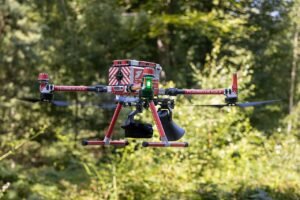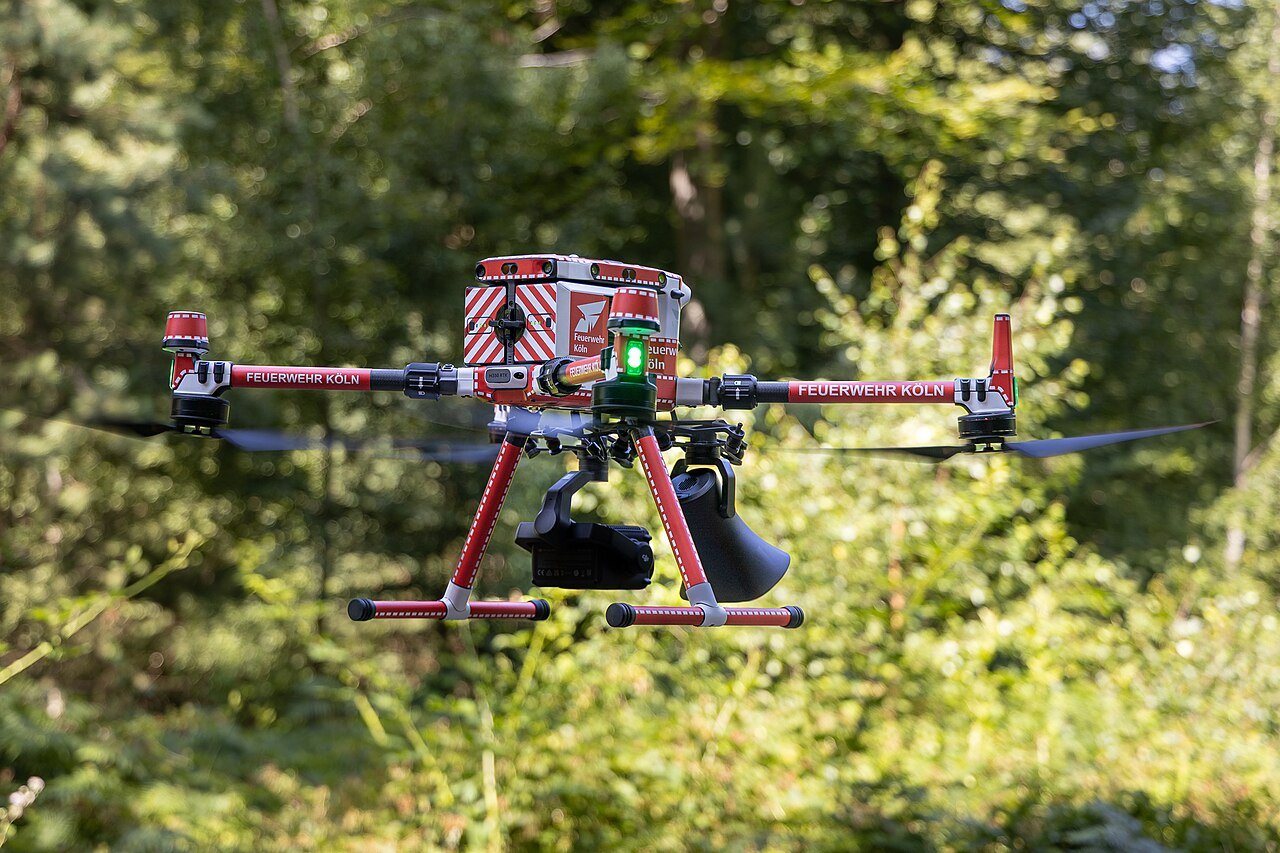
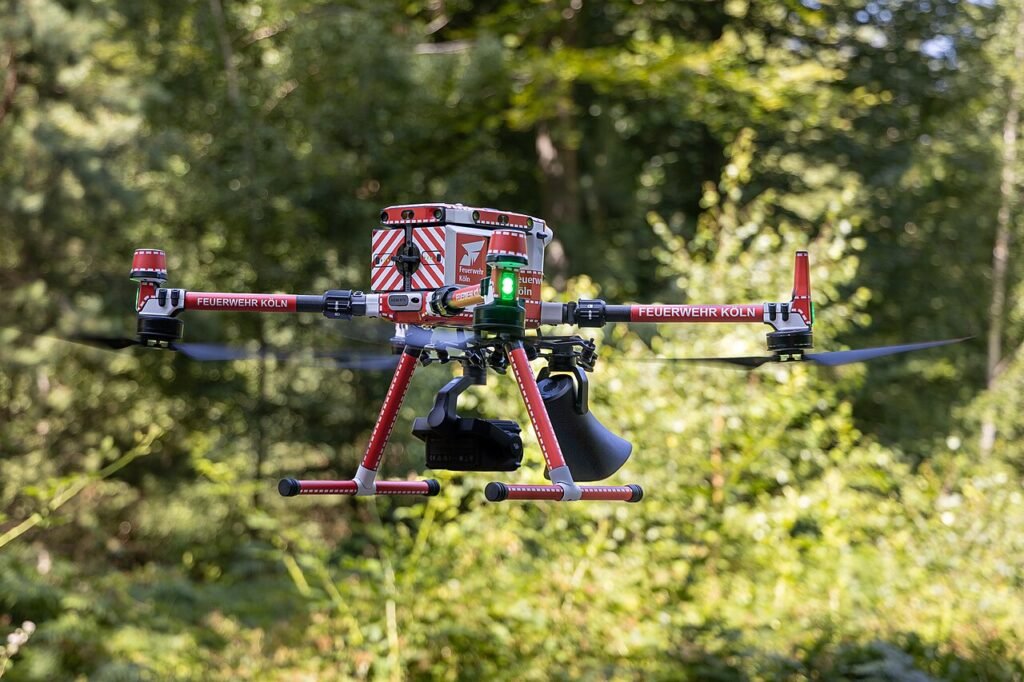
Photo: Superbass · Licence: CC BY-SA 4.0 · View the original source and licence terms.
DJI / DRONE PROFILE
DJI Matrice 350 RTK Review: TB65 Batteries, Payloads and RTK Accuracy
Explore the available technical information for this aircraft, including camera capabilities, flight performance and manufacturer-specific specifications.
The DJI Matrice 350 RTK (M350 RTK) is a professional enterprise drone platform designed for inspection, surveying, public safety and industrial operations. It builds on DJI’s heavy-duty Matrice platform with a TB65 battery system, O3 Enterprise transmission, RTK positioning and support for multiple gimbal configurations and certified payloads.
Payload and gimbal flexibility
The M350 RTK supports compatible payloads including Zenmuse H30/H30T, H20/H20T/H20N, L2, L1, P1, S1 and V1. Supported configurations include single downward, single upward, dual downward, upward-and-downward and triple-gimbal arrangements. DJI lists a maximum payload of 960g for a single gimbal damper; payload limits should be checked against the exact mounting configuration and total takeoff weight.
RTK positioning and flight control
The aircraft supports GPS, GLONASS, BeiDou and Galileo. DJI lists RTK FIX positioning accuracy of 1cm + 1ppm horizontally and 1.5cm + 1ppm vertically. This requires a functioning RTK correction workflow and suitable satellite visibility. Standard GNSS and vision-positioning accuracy are less precise, so the RTK value should not be treated as guaranteed in every flight.
TB65 batteries and flight performance
With two TB65 batteries, DJI lists an aircraft weight of approximately 6.47kg in the single-downward-gimbal configuration and a maximum takeoff weight of 9.2kg. Maximum flight time is 55 minutes in a windless test without payloads. Maximum wind resistance is 12m/s. The service ceiling depends on propeller type and takeoff weight: DJI lists 5,000m with 2110s propellers and 7,000m with 2112 high-altitude propellers under specified weight limits.
DJI Matrice 350 RTK specifications
| Specification | Matrice 350 RTK |
|---|---|
| Weight with two TB65 batteries | Approx. 6.47kg (single downward gimbal configuration) |
| Maximum takeoff weight | 9.2kg |
| Single gimbal damper maximum payload | 960g |
| Maximum flight time | 55min (DJI test conditions) |
| Maximum wind resistance | 12m/s |
| RTK accuracy | 1cm + 1ppm horizontal; 1.5cm + 1ppm vertical |
| Ingress protection | IP55 (with specified TB65 battery and properly sealed aircraft) |
| Battery | TB65, 5,880mAh, 263.2Wh |
| Supported gimbals | H30/H30T, H20/H20T/H20N, L2/L1, P1, S1, V1 |
| GNSS | GPS + GLONASS + BeiDou + Galileo |
| Operating temperature | -20°C to 50°C |
IP55 protection and operating limits
DJI specifies IP55 protection when the aircraft is configured correctly with TB65 batteries and all covers and seals are properly installed. DJI also warns that the rating is not permanent and can decrease with wear. It is not permission to fly in heavy rain or with damaged seals. Inspect the aircraft and battery compartment before every mission.
Who should consider the M350 RTK?
The M350 RTK is designed for enterprise teams that need a configurable heavy-duty aircraft and a wide payload ecosystem. Its total system cost includes batteries, charging station, controller, payloads, RTK correction service, maintenance and trained operators. It is not intended for casual consumer photography.
Official source and specification notes
Specifications are based on DJI’s official Matrice 350 RTK specifications and DJI support documentation. The 55-minute figure is a no-payload manufacturer test result. IP55 depends on correct aircraft condition and battery configuration. This is a specification-based review, not a claim of hands-on testing.
Related IGIDRONE reading
Compare this aircraft with related enterprise models: DJI Matrice 300 RTK review | DJI Matrice 400 review.
Transmission, dimensions and mission planning
The aircraft measures 810 × 670 × 430mm unfolded without propellers and 430 × 420 × 430mm folded with propellers. DJI O3 Enterprise uses four video-transmission antennas and lists a maximum unobstructed transmission distance of 20km under FCC conditions and 8km under CE/SRRC/MIC conditions. These are regulatory and laboratory-style reference figures; obstacles, radio interference, antenna orientation and local frequency rules can reduce usable range. Maximum horizontal speed is 23m/s, with maximum ascent and vertical descent speeds of 6m/s and 5m/s.
For planning, account for the payload, battery temperature, wind, return-to-home reserve and the time needed to complete the inspection or survey. A 55-minute maximum test figure is not a sensible mission-duration target.
Who should consider DJI Matrice 350 RTK Review: TB65 Batteries, Payloads and RTK Accuracy?
For a fleet, compare the model against the existing operating standard. Consider pilot retraining, battery inventory, spare parts, payload transfer, software licences, data migration, security review and service continuity. A technically newer aircraft is not automatically the lowest-risk upgrade if it changes established procedures or payload compatibility. For DJI Matrice 350 RTK Review: TB65 Batteries, Payloads and RTK Accuracy, request written confirmation for the exact aircraft, payload, mount, firmware and software combination.
Limitations and trade-offs to understand
For government and critical-infrastructure procurement, review cybersecurity, data residency, account permissions, encryption, update policy, audit logs and support lifecycle. Confirm the organisation's own security and procurement requirements with the manufacturer and supplier before uploading sensitive mission data. For DJI Matrice 350 RTK Review: TB65 Batteries, Payloads and RTK Accuracy, validate representative mission data against the organisation’s accuracy and reporting requirements before fleet purchase.
Alternatives worth comparing
Compare the model with the DJI Matrice 4E for mapping-oriented work, Matrice 4T or 5T for thermal missions, Matrice 4D/4TD for dock-based workflows, and the Matrice 350 RTK or Matrice 400 for larger enterprise payload needs. These platforms have different payload and operating ecosystems; verify the exact model variant and compatibility. For DJI Matrice 350 RTK Review: TB65 Batteries, Payloads and RTK Accuracy, include service turnaround, spare batteries, training and data governance in the procurement comparison.
Pre-purchase and ownership checklist
Ask for a payload compatibility matrix, current user manual, firmware support statement, service-level commitment, battery replacement cost, cybersecurity documentation and a representative sample data set. Include operator training, insurance, maintenance, spare parts and software in the total-cost calculation. For DJI Matrice 350 RTK Review: TB65 Batteries, Payloads and RTK Accuracy, test the failsafe and communications-loss procedure at the intended operating site.
How to use this specification profile
This page is a research-based reference, not a claim that IGIDRONE has independently flight-tested the aircraft. Treat manufacturer maximums as test-condition figures and distinguish standard equipment from optional accessories or regional bundles. Before buying, compare the exact model code, firmware, battery, controller and payload configuration against the current official manual. If a field is marked unknown or is not documented by the manufacturer, do not infer a value from a similarly named variant. For DJI Matrice 350 RTK Review: TB65 Batteries, Payloads and RTK Accuracy, request written confirmation for the exact aircraft, payload, mount, firmware and software combination.
Primary manufacturer reference: Open the manufacturer specification or support page. Confirm the current regional documentation before purchase. For DJI Matrice 350 RTK Review: TB65 Batteries, Payloads and RTK Accuracy, validate representative mission data against the organisation’s accuracy and reporting requirements before fleet purchase.
Editorial update: 8 November 2026. Model availability, prices, software support and regional operating rules can change. Confirm them with the manufacturer, authorised distributor and relevant aviation authority before purchase or flight. For DJI Matrice 350 RTK Review: TB65 Batteries, Payloads and RTK Accuracy, include service turnaround, spare batteries, training and data governance in the procurement comparison.
Drone Specifications
| Brand | DJI |
|---|---|
| Camera | Payload-dependent enterprise gimbal platform |
| Maximum Flight Time (minutes) | 55 min (without payload, windless test; not typical mission time) minutes |
| Maximum Transmission Range (km) | 20 km (FCC); 8 km (CE/SRRC/MIC) km |
| Weight (g) | 6470 g g |
| Battery Capacity (mAh) | Intelligent Flight Battery: 5880 mAh mAh |
| Wind Resistance (m/s) | 12 m/s m/s |
| Obstacle Sensing | Six-directional vision and infrared sensing |
| Positioning / GPS | GPS, GLONASS, BeiDou, Galileo; RTK |
| Maximum Speed (m/s) | 23 m/s m/s |
Additional Notes
Matrice 350 RTK review entry: see official aircraft table. Approx. 3.77 kg without batteries / 6.47 kg with two TB65 batteries; max takeoff weight 9.2 kg; max no-payload flight time 55 min; IP55; RTK fixed accuracy 1 cm + 1 ppm horizontal / 1.5 cm + 1 ppm vertical.
Specification source: Official source
Last verified: 2026-11-07
Official Price (USD)
No public USD price was verified on the manufacturer’s official store during this check.
For enterprise or discontinued models, contact the manufacturer for a current quotation. We do not substitute third-party seller prices.
Price checked: 2026-11-07
MODEL TECHNICAL RECORD
Detailed Technical Specifications
Manufacturer-specific technical information recorded for this model. Values not present in the source record are not estimated.
Aircraft
| Dimensions (unfolded, without propellers) | 810×670×430 mm (L×W×H) |
|---|---|
| Dimensions (folded, with propellers) | 430×420×430 mm (L×W×H) |
| Diagonal Wheelbase | 895 mm |
| Weight (with single downward gimbal) | Without batteries: Approx. 3.77 kg With two TB65 batteries: Approx. 6.47 kg |
| Single Gimbal Damper’s Max Payload | 960 g |
| Max Takeoff Weight | 9.2 kg |
| Operating Frequency | 2.4000-2.4835 GHz 5.150-5.250 GHz (CE: 5.170-5.250 GHz) 5.725-5.850 GHz In some countries and regions, the 5.1GHz and 5.8GHz frequency bands are prohibited, or the 5.1GHz frequency band is only allowed for indoor use. Please refer to local laws and regulations for more information. |
| Transmitter Power (EIRP) | 2.4000-2.4835 GHz: < 33 dBm (FCC) < 20 dBm (CE/SRRC/MIC) 5.150-5.250 GHz (CE: 5.170-5.250 GHz): < 23 dBm (CE) 5.725-5.850 GHz: < 33 dBm (FCC/SRRC) < 14 dBm (CE) |
| Hovering Accuracy (with moderate or no wind) | Vertical: ±0.1 m (with vision positioning) ±0.5 m (with GNSS positioning) ±0.1 m (with RTK positioning) Horizontal: ±0.3 m (with vision positioning) ±1.5 m (with GNSS positioning) ±0.1 m (with RTK positioning) |
| RTK Positioning Accuracy (RTK FIX) | 1 cm + 1 ppm (horizontal) 1.5 cm + 1 ppm (vertical) |
| Max Angular Velocity | Pitch: 300°/s Yaw: 100°/s |
| Max Pitch Angle | 30° When in N mode and with the forward vision system enabled: 25°. |
| Max Ascent Speed | 6 m/s |
| Max Descent Speed (vertical) | 5 m/s |
| Max Tilted Descent Speed | 7 m/s |
| Max Horizontal Speed | 23 m/s |
| Max Flight Altitude | 5000 m When using the 2110s propellers and with the takeoff weight ≤ 7.4 kg. 7000 m When using the 2112 High-Altitude Low-Noise Propellers and with the takeoff weight ≤ 7.2 kg. |
| Max Wind Speed Resistance | 12 m/s |
| Max Flight Time | 55 minutes Measured with Matrice 350 RTK flying at approximately 8 m/s without payloads in a windless environment until the battery level reached 0%. Data is for reference only. Actual usage time may vary depending on the flight mode, accessories, and environment. Please pay attention to reminders in the app. |
| Supported DJI Gimbals | Zenmuse H30, Zenmuse H30T, Zenmuse H20, Zenmuse H20T, Zenmuse H20N, Zenmuse L2, Zenmuse L1, Zenmuse P1, Zenmuse S1, and Zenmuse V1 |
| Third-Party Payload | Supports only certified payloads developed based on DJI Payload SDK. |
| Supported Gimbal Configurations | Single downward gimbal Single upward gimbal Dual downward gimbals Single downward gimbal + single upward gimbal Dual downward gimbals + single upward gimbal |
| Ingress Protection Rating | IP55 The IP rating is not permanently effective and may decrease due to product wear and tear. |
| Global Navigation Satellite System | GPS + GLONASS + BeiDou + Galileo |
| Operating Temperature | -20° to 50° C (-4° to 122° F) |
| Class | C3 (EU) |
Remote Controller
| Screen | 7.02-inch LCD touchscreen; resolution: 1920×1200; max brightness: 1200 nits |
|---|---|
| Weight | Approx. 1.25 kg (without WB37 battery) Approx. 1.42 kg (with WB37 battery) |
| Global Navigation Satellite System | GPS + Galileo + BeiDou |
| Built-in Battery | Type: Li-ion (6500 mAh@7.2 V) Charging Type: Use the battery station or USB-C fast charger with a max power of 65 W (max voltage of 20 V). Charging Time: 2 hours Chemical System: LiNiCoAlO2 |
| External Battery (WB37 Intelligent Battery) | Capacity: 4920 mAh Voltage: 7.6 V Type: Li-ion Energy: 37.39 Wh Chemical System: LiCoO2 |
| Ingress Protection Rating | IP54 |
| Operating Time | Built-in Battery: approx. 3.3 hours Built-in Battery + External Battery: approx. 6 hours |
| Operating Temperature | -20° to 50° C (-4° to 122° F) |
| Operating Frequency | 2.4000-2.4835 GHz 5.725-5.850 GHz |
| Transmitter Power (EIRP) | 2.4000-2.4835 GHz: < 33 dBm (FCC) < 20 dBm (CE/SRRC/MIC) 5.725-5.850 GHz: < 33 dBm (FCC) < 14 dBm (CE) < 23 dBm (SRRC) |
| Wi-Fi Protocol | Wi-Fi 6 |
| Wi-Fi Operating Frequency | 2.4000-2.4835 GHz 5.150-5.250 GHz 5.725-5.850 GHz |
| Bluetooth Protocol | Bluetooth 5.1 |
| Bluetooth Operating Frequency | 2.4000-2.4835 GHz |
Video Transmission
| Video Transmission System | DJI O3 Enterprise Transmission |
|---|---|
| Antenna | 4 video transmission antennas, 2T4R |
| Max Transmission Distance (unobstructed, free of interference) | 20 km (FCC) 8 km (CE/SRRC/MIC) |
| Max Transmission Distance (with interference) | Low Interference and Obstructed by Buildings: approx. 0-0.5 km Low Interference and Obstructed by Trees: approx. 0.5-3 km Strong Interference and Unobstructed: urban landscape, approx. 1.5-3 km Medium Interference and Unobstructed: suburban landscape, approx. 3-9 km Low Interference and Unobstructed: suburb/seaside, approx. 9-20 km Measured with FCC compliance in unobstructed environments with typical interference at a flight altitude of approximately 120 m. Data is for reference only. The actual transmission distance may vary depending on the environment’s obstruction and interference conditions. Please pay attention to reminders in the app. |
Vision System
| Obstacle Sensing Range | Forward/Backward/Left/Right: 0.7-40 m Upward/Downward: 0.6-30 m |
|---|---|
| FOV | Forward/Backward/Downward: 65° (horizontal), 50° (vertical) Left/Right/Upward: 75° (horizontal), 60° (vertical) |
| Operating Environment | Surfaces with discernible patterns and adequate lighting (lux > 15) |
Infrared Sensing System
| Obstacle Sensing Range | 0.1-8 m |
|---|---|
| FOV | 30° (±15°) |
| Operating Environment | Large, diffuse, and reflective obstacles (reflectivity > 10%) |
LED Auxiliary Light
| Effective Illumination Distance | 5 m |
|---|---|
| Illumination Type | 60 Hz, solid glow |
FPV Camera
| Resolution | 1080p |
|---|---|
| FOV | 142° |
| Frame Rate | 30fps |
Intelligent Flight Battery
| Model | TB65 |
|---|---|
| Capacity | 5880 mAh |
| Voltage | 44.76 V |
| Type | Li-ion |
| Energy | 263.2 Wh |
| Weight | Approx. 1.35 kg |
| Operating Temperature | -20° to 50° C (-4° to 122° F) |
| Ideal Storage Temperature | 22° to 30° C (71.6° to 86° F) |
| Charging Temperature | -20° to 40° C (-4° to 104° F) When the ambient temperature is below 5° C (41° F), the battery will trigger the auto-heating function. Charging at low temperatures may reduce battery life. It is recommended to charge at 15° to 35° C (59° to 95° F). |
| Charging Time | With a 220V power supply, it takes approximately 60 minutes to fully charge two TB65 Intelligent Flight Batteries and approximately 30 minutes to charge them from 20% to 90%. With a 110V power supply, it takes approximately 70 minutes to fully charge two TB65 Intelligent Flight Batteries and approximately 40 minutes to charge them from 20% to 90%. |
Intelligent Battery Station
| Dimensions | 580×358×254 mm (L×W×H) |
|---|---|
| Net Weight | Approx. 8.98 kg |
| Compatible Stored Items | Eight TB65 Intelligent Flight Batteries Four WB37 Intelligent Batteries |
| Input Voltage | 100-120 VAC, 50-60 Hz 220-240 VAC, 50-60 Hz |
| Max Input Power | 1070 W |
| Output Power | 100-120 V: 750 W 220-240 V: 992 W |
| Operating Temperature | -20° to 40° C (-4° to 104° F) |
Others
| Guaranteed software updates until | 2025/12/31 |
|---|


Aircraft & Flight
| Maximum horizontal speed | 23 m/s |
|---|---|
| Maximum takeoff weight | 9.2 kg |
Navigation & Obstacle Sensing
| Supported GNSS systems | GPS + GLONASS + BeiDou + Galileo |
|---|
Operating Conditions & Dimensions
| Maximum wind resistance | 12 m/s |
|---|
MANUFACTURER DATA
Detailed official specifications
Technical figures below are transcribed from the manufacturer documentation linked with this profile. Test figures are maximum or controlled-condition ratings where stated; actual performance varies by configuration and operating conditions. A field is omitted when the cited source does not publish a reliable value.
Manufacturer source last checked: 2026-11-07
Evidence type: Official manufacturer specifications / support documentation
Aircraft
| Dimensions (unfolded, without propellers) | 810 × 670 × 430 mm (L × W × H) |
|---|---|
| Dimensions (folded, with propellers) | 430 × 420 × 430 mm (L × W × H) |
| Diagonal Wheelbase | 895 mm |
| Weight (with single downward gimbal) | Without batteries: ; Approx. 3.77 kg; ; With two TB65 batteries: ; Approx. 6.47 kg |
| Single Gimbal Damper’s Max Payload | 960 g |
| Maximum takeoff weight | 9.2 kg |
| Operating Frequency | 2.4000-2.4835 GHz; 5.150-5.250 GHz (CE: 5.170-5.250 GHz); 5.725-5.850 GHz; ; In some countries and regions, the 5.1GHz and 5.8GHz frequency bands are prohibited, or the 5.1GHz frequency band is only allowed for indoor use. Please refer to local laws and regulations for more information. |
| Transmitter Power (EIRP) | 2.4000-2.4835 GHz: ; < 33 dBm (FCC); < 20 dBm (CE/SRRC/MIC); ; 5.150-5.250 GHz (CE: 5.170-5.250 GHz): ; < 23 dBm (CE); ; 5.725-5.850 GHz: ; < 33 dBm (FCC/SRRC); < 14 dBm (CE) |
| Hovering Accuracy (with moderate or no wind) | Vertical: ; ±0.1 m (with vision positioning); ±0.5 m (with GNSS positioning); ±0.1 m (with RTK positioning); ; Horizontal: ; ±0.3 m (with vision positioning); ±1.5 m (with GNSS positioning); ±0.1 m (with RTK positioning) |
| RTK Positioning Accuracy (RTK FIX) | 1 cm + 1 ppm (horizontal); 1.5 cm + 1 ppm (vertical) |
| Max Angular Velocity | Pitch: 300°/s; Yaw: 100°/s |
| Max Pitch Angle | 30°; When in N mode and with the forward vision system enabled: 25°. |
| Maximum ascent speed | 6 m/s |
| Max Descent Speed (vertical) | 5 m/s |
| Max Tilted Descent Speed | 7 m/s |
| Maximum horizontal speed | 23 m/s |
| Max Flight Altitude | 5000 m; When using the 2110s propellers and with the takeoff weight ≤ 7.4 kg. ; ; 7000 m; When using the 2112 High-Altitude Low-Noise Propellers and with the takeoff weight ≤ 7.2 kg. |
| Maximum wind resistance | 12 m/s |
| Maximum flight time | 55 minutes; Measured with Matrice 350 RTK flying at approximately 8 m/s without payloads in a windless environment until the battery level reached 0%. Data is for reference only. Actual usage time may vary depending on the flight mode, accessories, and environment. Please pay attention to reminders in the app. |
| Supported DJI Gimbals | Zenmuse H30, Zenmuse H30T, Zenmuse H20, Zenmuse H20T, Zenmuse H20N, Zenmuse L2, Zenmuse L1, Zenmuse P1, Zenmuse S1, and Zenmuse V1 |
| Third-Party Payload | Supports only certified payloads developed based on DJI Payload SDK. |
| Supported Gimbal Configurations | Single downward gimbal; Single upward gimbal; Dual downward gimbals; Single downward gimbal + single upward gimbal; Dual downward gimbals + single upward gimbal |
| Ingress Protection Rating | IP55; The IP rating is not permanently effective and may decrease due to product wear and tear. |
| Global Navigation Satellite System | GPS + GLONASS + BeiDou + Galileo |
| Operating temperature range | -20° to 50°C (-4° to 122° F) |
| Class | C3 (EU) |
Remote Controller
| Screen | 7.02-inch LCD touchscreen; resolution: 1920 × 1200; max brightness: 1200 nits |
|---|---|
| Weight | Approx. 1.25 kg (without WB37 battery); Approx. 1.42 kg (with WB37 battery) |
| Global Navigation Satellite System | GPS + Galileo + BeiDou |
| Built-in Battery | Type: Li-ion (6500 mAh@7.2 V); Charging Type: Use the battery station or USB-C fast charger with a max power of 65 W (max voltage of 20 V).; Charging Time: 2 hours; Chemical System: LiNiCoAlO2 |
| External Battery (WB37 Intelligent Battery) | Capacity: 4920 mAh; Voltage: 7.6 V; Type: Li-ion; Energy: 37.39 Wh; Chemical System: LiCoO2 |
| Ingress Protection Rating | IP54 |
| Operating Time | Built-in Battery: approx. 3.3 hours; Built-in Battery + External Battery: approx. 6 hours |
| Operating temperature range | -20° to 50°C (-4° to 122° F) |
| Operating Frequency | 2.4000-2.4835 GHz; 5.725-5.850 GHz |
| Transmitter Power (EIRP) | 2.4000-2.4835 GHz: ; < 33 dBm (FCC); < 20 dBm (CE/SRRC/MIC); ; 5.725-5.850 GHz: ; < 33 dBm (FCC); < 14 dBm (CE); < 23 dBm (SRRC) |
| Wi-Fi Protocol | Wi-Fi 6 |
| Wi-Fi Operating Frequency | 2.4000-2.4835 GHz; 5.150-5.250 GHz; 5.725-5.850 GHz |
| Bluetooth Protocol | Bluetooth 5.1 |
| Bluetooth Operating Frequency | 2.4000-2.4835 GHz |
Video Transmission
| Video Transmission System | DJI O3 Enterprise Transmission |
|---|---|
| Antenna | 4 video transmission antennas, 2T4R |
| Max Transmission Distance (unobstructed, free of interference) | 20 km (FCC); 8 km (CE/SRRC/MIC) |
| Max Transmission Distance (with interference) | Low Interference and Obstructed by Buildings: approx. 0-0.5 km; Low Interference and Obstructed by Trees: approx. 0.5-3 km; Strong Interference and Unobstructed: urban landscape, approx. 1.5-3 km; Medium Interference and Unobstructed: suburban landscape, approx. 3-9 km; Low Interference and Unobstructed: suburb/seaside, approx. 9-20 km; ; Measured with FCC compliance in unobstructed environments with typical interference at a flight altitude of approximately 120 m. Data is for reference only. The actual transmission distance may vary depending on the environment’s obstruction and interference conditions. Please pay attention to reminders in the app. |
Vision System
| Obstacle Sensing Range | Forward/Backward/Left/Right: 0.7-40 m; Upward/Downward: 0.6-30 m |
|---|---|
| FOV | Forward/Backward/Downward: 65° (horizontal), 50° (vertical); Left/Right/Upward: 75° (horizontal), 60° (vertical) |
| Operating Environment | Surfaces with discernible patterns and adequate lighting (lux > 15) |
Infrared Sensing System
| Obstacle Sensing Range | 0.1-8 m |
|---|---|
| FOV | 30° (±15°) |
| Operating Environment | Large, diffuse, and reflective obstacles (reflectivity > 10%) |
LED Auxiliary Light
| Effective Illumination Distance | 5 m |
|---|---|
| Illumination Type | 60 Hz, solid glow |
FPV Camera
| Resolution | 1080p |
|---|---|
| FOV | 142° |
| Frame Rate | 30fps |
Intelligent Flight Battery
| Model | TB65 |
|---|---|
| Capacity | 5880 mAh |
| Voltage | 44.76 V |
| Type | Li-ion |
| Energy | 263.2 Wh |
| Weight | Approx. 1.35 kg |
| Operating temperature range | -20° to 50°C (-4° to 122° F) |
| Ideal Storage Temperature | 22° to 30°C (71.6° to 86° F) |
| Charging Temperature | -20° to 40°C (-4° to 104° F); When the ambient temperature is below 5°C (41° F), the battery will trigger the auto-heating function. Charging at low temperatures may reduce battery life. It is recommended to charge at 15° to 35°C (59° to 95° F). |
| Charging Time | With a 220V power supply, it takes approximately 60 minutes to fully charge two TB65 Intelligent Flight Batteries and approximately 30 minutes to charge them from 20% to 90%. ; With a 110V power supply, it takes approximately 70 minutes to fully charge two TB65 Intelligent Flight Batteries and approximately 40 minutes to charge them from 20% to 90%. |
Intelligent Battery Station
| Dimensions | 580 × 358 × 254 mm (L × W × H) |
|---|---|
| Net Weight | Approx. 8.98 kg |
| Compatible Stored Items | Eight TB65 Intelligent Flight Batteries; Four WB37 Intelligent Batteries |
| Input Voltage | 100-120 VAC, 50-60 Hz; 220-240 VAC, 50-60 Hz |
| Max Input Power | 1070 W |
| Output Power | 100-120 V: 750 W; 220-240 V: 992 W |
| Operating temperature range | -20° to 40°C (-4° to 104° F) |
Others
| Guaranteed software updates until | 2025/12/31 |
|---|
Source: manufacturer technical specifications and official support documentation. Regional versions, payloads, batteries, firmware and test conditions can change the stated figures. Check the linked source for the applicable configuration.
Related Dji drones
Explore other published models from the same manufacturer.