
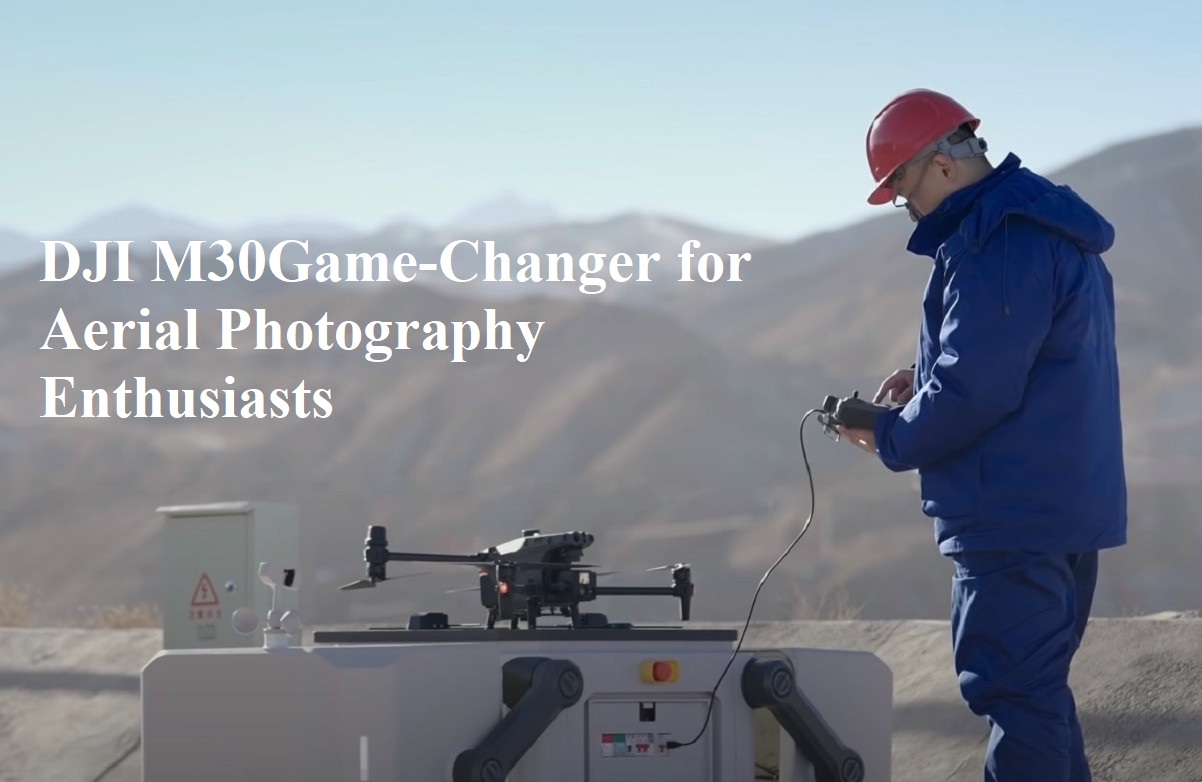
The DJI Matrice 30 (M30) is a compact enterprise drone designed for inspection, public-safety, emergency-response and infrastructure operations. It combines a foldable airframe with an integrated wide camera, zoom camera, laser rangefinder and enterprise flight systems. This guide focuses on the standard M30 and distinguishes it from the thermal-equipped M30T.
DJI M30 and M30T: an important camera difference
The standard Matrice 30 includes a 12 MP wide camera and a 48 MP zoom camera with 5×–16× optical zoom and up to 200× hybrid zoom. The Matrice 30T adds a thermal imaging camera. The thermal camera should therefore not be listed as a standard M30 feature. Both variants include a laser rangefinder and an FPV camera.
Key DJI Matrice 30 specifications
- Maximum flight time: up to 41 minutes in DJI’s stated test conditions.
- Maximum horizontal speed: 23 m/s.
- Maximum wind resistance: 12 m/s.
- Ingress protection: IP55, subject to wear and use conditions.
- Operating temperature: -20°C to 50°C.
- Wide camera: 12 MP, 1/2-inch CMOS, 4K/30fps video.
- Zoom camera: 48 MP, 1/2-inch CMOS, 5×–16× optical zoom, 4K/30fps video.
- Laser rangefinder: measuring range of 3–1,200 m under DJI’s stated conditions.
- Video transmission: O3 Enterprise; maximum unobstructed distance varies by regulatory region (up to 15 km FCC and 8 km CE/SRRC/MIC).
These are manufacturer maximums or laboratory figures, not guaranteed results in every flight. Payload, weather, battery condition, interference, local radio rules and operating technique can affect real-world performance.
Flight performance and field operation
The M30 is built for teams that need to deploy quickly and collect useful information in demanding environments. Its foldable design makes transport and setup more practical than a large fixed-frame platform. DJI specifies six-sided vision and infrared sensing, GNSS support and RTK positioning capability. These systems can assist with positioning and obstacle awareness, but they do not replace a trained pilot, mission planning or visual risk assessment.
The aircraft uses TB30 intelligent flight batteries and a compatible battery station. DJI’s published 41-minute maximum flight time is a controlled-condition figure; operators should plan missions with a reserve and account for wind, temperature, payload and battery age.
What is the M30 suitable for?
- Public safety: rapid situational awareness and aerial observation.
- Infrastructure inspection: zoom-camera inspection of structures and equipment from a suitable stand-off distance.
- Search and rescue: wide-area visual observation; choose the M30T when thermal imaging is required.
- Industrial operations: documenting sites and inspecting assets where an enterprise workflow is appropriate.
Is the DJI M30 still worth considering?
The M30 remains a capable enterprise platform when its integrated camera payload and portability match the job. Buyers should compare the standard M30 with the M30T carefully, confirm payload requirements, check local availability and support, and review current firmware and regulatory requirements before purchasing. Do not rely on old online price figures: package contents, service plans and regional dealer pricing can change.
DJI M30 vs other DJI models
For other DJI enterprise platforms, see our DJI Matrice 350 RTK guide and Matrice 300 RTK review. You can also use the DJI drone comparison tool to compare available DJI models.
Official source and verification
Specifications in this article are based on DJI’s official Matrice 30 Series specifications. Always check the manufacturer page for the latest regional details and limitations.
n
Browse the IGIDRONE DJI drone catalogue for the DJI models currently covered on this site.